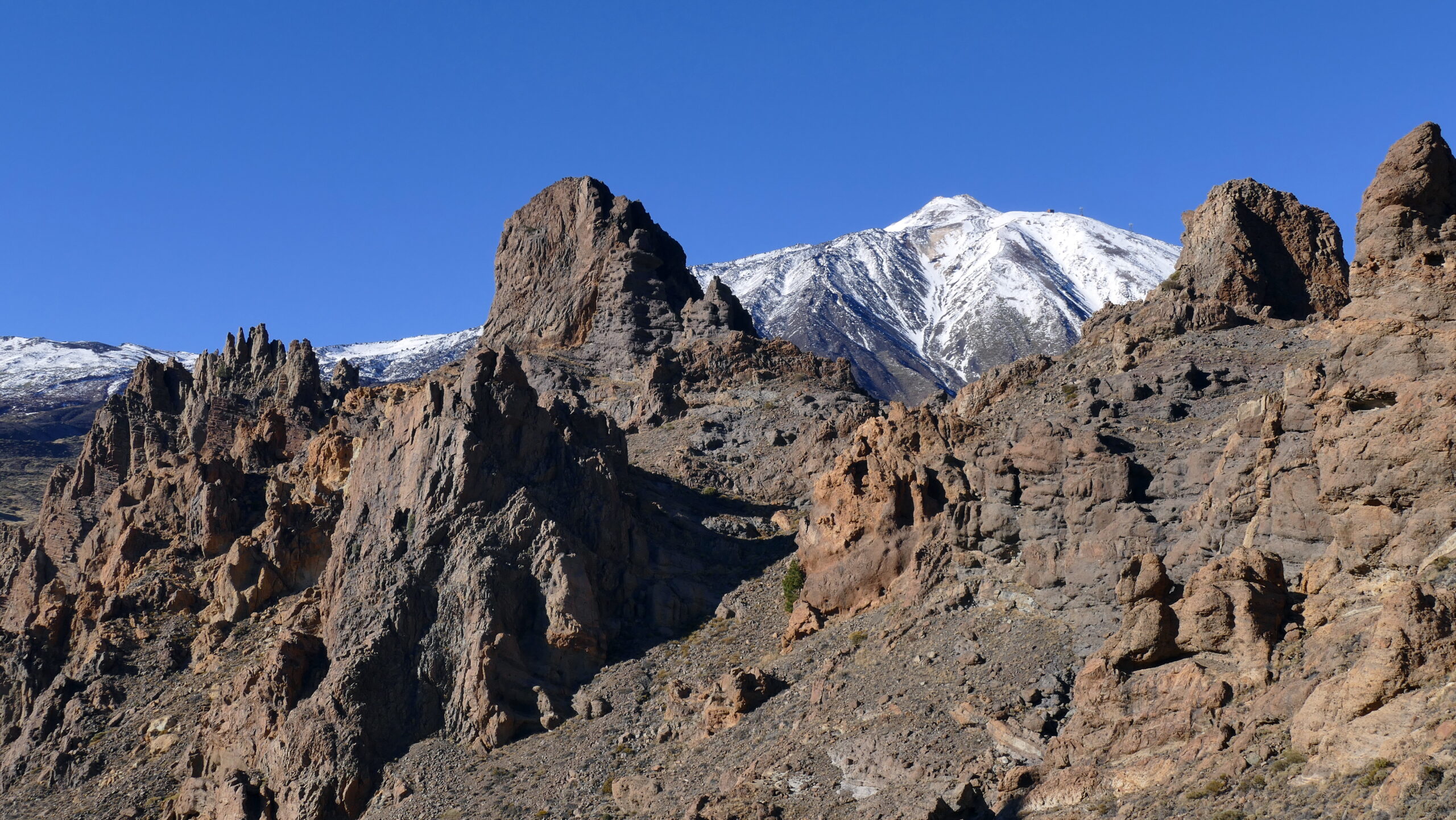
From Los Gigantes, Teide is not a day trip so much as a commute: about 52 km and an hour and ten minutes, most of it on the TF-38 — the quietest and best-surfaced of the four roads into the national park, climbing through pine forest and then across the bare lava of the 1798 eruption. You leave the coast in beach weather and step out at 2,000 metres into mountain air. A few numbers have changed recently, so everything below is as of July 2026.
The drive, and where to stop
The route runs Los Gigantes → Tamaimo (TF-454) → TF-82 past Chío, then the TF-38 all the way up to the Boca Tauce junction inside the caldera. Fill the tank in Tamaimo or Chío — there is no fuel beyond, and none anywhere inside the park. Worthwhile pauses on the way up: the Mirador de Chío for the view back over the Santiago del Teide valley to the sea, the Mirador de Samara (start of a beautiful circular walk over black ash among pines), and the Narices del Teide viewpoint facing the vents of the 1798 eruption. There is no practical public bus from this side of the island (the park bus runs once a day from Costa Adeje), so it is your car or an organised excursion; several coach tours pick up in Los Gigantes and Puerto de Santiago on set days.
The cable car
The teleférico climbs from 2,356 m to La Rambleta at 3,555 m in eight minutes. A return is €42 per adult and €21 per child (3–13) at the official site, volcanoteide.com — book online, both for the price and because midday slots sell out. Hours are seasonal, with last ascents mid-to-late afternoon and extended summer closing; the car shuts down in high wind and snow, so check the live “Teide Today” page the same morning — tickets are refundable or reschedulable when it closes. From the top station two short, free trails lead to the Pico Viejo and La Fortaleza viewpoints, no permit needed, and the views over the caldera to La Gomera and Gran Canaria are the postcard everyone came for. The cable car is barred to children under three, pregnant women and people with heart conditions — the altitude is genuine.
The summit now costs €15 — and sells out
The final 163 vertical metres from La Rambleta to the crater rim (the Telesforo Bravo trail) have always needed a permit; since 19 January 2026 that permit also carries a fee — €15 for most visitors, €6 for residents of other Canary islands, free for Tenerife residents and under-14s. Only 300 people a day are admitted, in four two-hour slots, booked at tenerifeon.es; new dates are released every Monday at 07:00 Canary time for the following 28 days, and high-season slots go within minutes. Permits are personal — staff check ID at the trail gate — and non-refundable except when weather closes the mountain. The Montaña Blanca ascent path is now fee-controlled in daytime as well, and the Altavista mountain refuge remains closed, so the old overnight route to a permit-free dawn summit is not currently an option. Many guides still describe the permit as free; they are out of date.
The best of the park without a permit
- The Roques de García loop is the park’s signature short walk: 3.5 km, about two hours, circling the rock towers (including the Roque Cinchado of old thousand-peseta-note fame) from the La Ruleta car park. Go early or late; the car park fills from mid-morning.
- Alto de Guajara (2,718 m) — the island’s third-highest summit and the single best frontal view of Teide, reached on foot from the caldera floor. A proper half-day hike, no permit, no fee.
- The Samara circuit covers the western volcano field nearest Los Gigantes, an easy loop over ash and lava with huge views, straight off the TF-38.
- La Rambleta viewpoints, included with any cable-car ticket, as above.
Altitude, cold and the diving rule
At 3,555 m the air carries roughly forty per cent less oxygen than the coast, and it shows: expect breathlessness on the mildest slope, drink water, skip the alcohol, and descend if a headache builds. Budget for a temperature some 10–15 °C below the coast plus wind chill (below freezing with snow is normal in winter), and remember the UV at altitude is ferocious even when the air feels cool. One rule matters especially in a diving town like ours: going up Teide counts as going to altitude, so after scuba diving apply the same waits as for flying — at least 12 hours after a single dive, 18 after repeated days, more after decompression dives. The cable car does not care that you feel fine. In winter, check the Cabildo road information or dial 012 before setting out: the TF-21 and TF-38 close for snow and ice, sometimes for days after a storm.
Stay for the stars
The park has been a certified Starlight Tourist Destination since 2014, with some of the clearest night skies in Europe — the observatory on the neighbouring ridge is there for a reason. The organised route is a sunset-and-stargazing tour with telescopes and certified guides (the cable-car operator’s version runs around €70 per adult; several independents sell similar evenings from about €35 — check current prices when booking). The do-it-yourself version is free. Drive up after dark, park at a marked layby such as the Minas de San José, or stop at the Mirador de Samara on the way home, and give your eyes twenty minutes. Aim for the days around new moon if the Milky Way is the goal; a full moon turns the lava fields silver instead, which is its own show.
Photo: Puusterke, CC BY-SA 4.0 (https://creativecommons.org/licenses/by-sa/4.0), via Wikimedia Commons