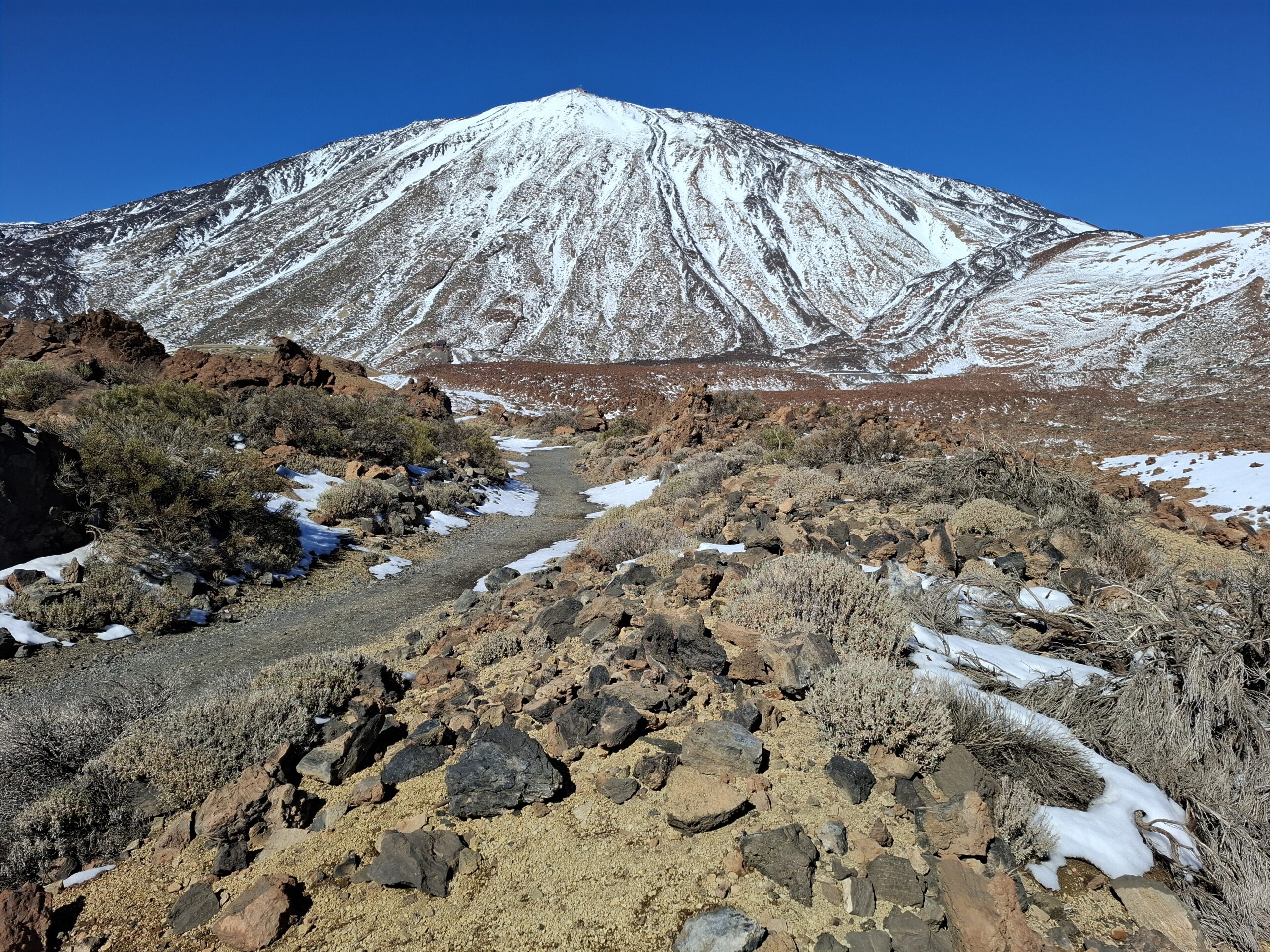
Everything you stand on here was once liquid. The Canaries are volcanic from shoreline to summit, and Tenerife wears the evidence openly: Los Gigantes’ cliffs are stacked lava, the 1909 Chinyero cone smokes with pine forest twenty minutes uphill, and above it all rises Teide — 3,715 metres, Spain’s highest peak, a UNESCO World Heritage national park since 2007. Prices and rules below are as in force in July 2026.
Doing Teide properly
The cable car (official operator Volcano Teide) climbs from 2,356 m to 3,555 m in eight minutes. It costs €42 return for non-resident adults (€21 for children), runs from 09:00 daily, and is prone to wind closures, so go early and book ahead. The last 160 metres to the crater rim are permit-only, and here is the change most guides have not caught up with: since 19 January 2026 the summit permit is no longer free. It costs €15 for non-residents, booked on the Cabildo’s tenerifeon.es platform, where each week’s block of roughly 200 daily places is released on Monday mornings and popular dates vanish within minutes. Plan four to eight weeks out, or book a guided summit package that includes the permit (top-rated ones run around 4.8 across hundreds of reviews, from about €149 with pickup). No permit? The free trails to the Pico Viejo viewpoint and around the Roques de García deliver the moonscape without the paperwork — and respect the altitude: the upper station sits at 3,555 m, which everyone feels.
Four eruptions to know
The first is 1706, when the Montañas Negras buried Garachico’s harbour; the town’s lava pools are its unlikely consolation prize. In 1798 came Narices del Teide, three months of flank eruption on Pico Viejo and the longest in the island’s records — Teide’s own summit crater has been silent for roughly a thousand years. Chinyero followed in 1909: ten days, in this very municipality, and the walking loop through its lava is covered in our hiking guide.
The fourth is Tajogaite on La Palma, which ran for 85 days in 2021, the island’s most destructive on record. Its crater zone now opens only with authorised guides (~€40, outstanding reviews); viewpoints and boat trips to the lava delta are free.
Lanzarote’s fire mountains
If the archipelago’s volcanism grabs you, Timanfaya on Lanzarote is the pilgrimage: the 1730–36 eruptions buried a quarter of the island, and the park’s bus route plus the geothermal demonstrations (water flashing to steam, brushwood igniting in a borehole) remain unmatched theatre. The official ticket is €30 (many blogs still quote €20; the park’s own shop says otherwise) with timed online booking now required.
Is it safe to holiday on a volcano?
Yes, and the specifics are more reassuring than the vague version. Teide has produced small seismic swarms through 2025 and 2026. The monitoring institutes INVOLCAN and IGN state plainly that these do not raise eruption probability, attribute them to hydrothermal fluids, and keep the alert at green, the lowest of four levels, under one of the densest monitoring networks in Europe. The same instruments gave La Palma days of warning in 2021. You will feel nothing; the volcano is simply breathing, and a hundred stations are listening.