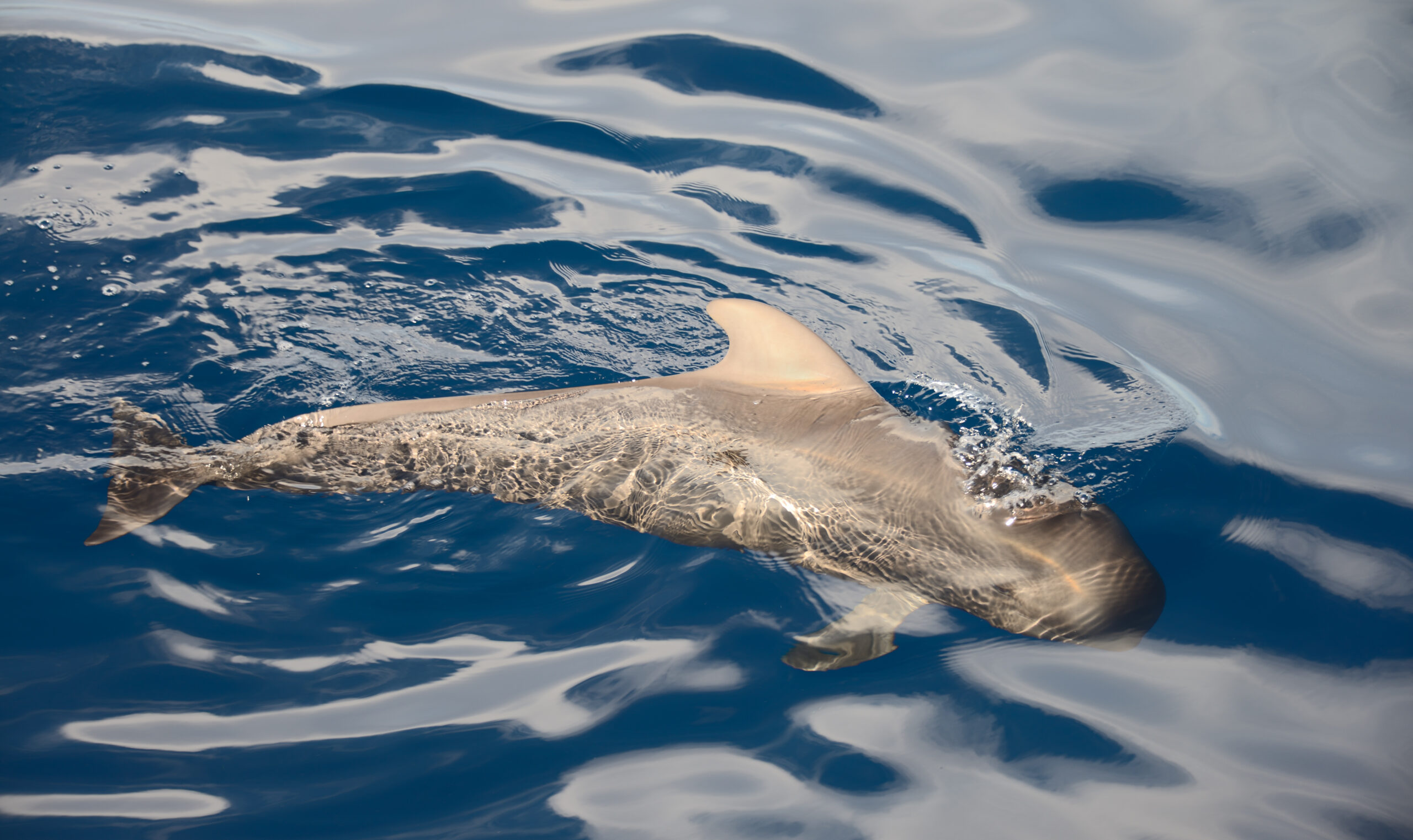
Most whale-watching destinations sell you a migration window: come in the right month or see nothing. Los Gigantes sells something rarer — residents. Short-finned pilot whales and bottlenose dolphins live in the channel between Tenerife and La Gomera all year round, one of only a handful of resident pilot-whale populations known anywhere in the world. The waters they occupy, the Franja Marina Teno-Rasca, were certified in January 2021 as Europe’s first Whale Heritage Site by the World Cetacean Alliance (some brochures say UNESCO — it is not a UNESCO title). And the boats leave from the marina at the bottom of the hill. Details below are as published in July 2026.
Who lives out there
How many pilot whales call the channel home depends on who you ask: tour operators usually say a few hundred, while the most rigorous scientific estimate, a photo-identification study of south-west Tenerife, puts the number somewhere between roughly 600 and 1,200 animals. Either way, family pods of these glossy, blunt-headed hunters rest at the surface by day between deep night-time dives for squid, which is exactly what makes them so watchable. Bottlenose dolphins patrol the same waters. Winter adds variety: sperm whales pass over the deep trenches roughly from December to April, Bryde’s whales are the baleen whale seen most often, and fin whales, spotted dolphins, even the odd orca turn up as bonuses — recorded occasionally, never promised.
Choosing your boat
The marina fleet covers every taste, and prices below are the operators’ published rates in July 2026. Flipper Uno, the timber “pirate ship”, is the family crowd-pleaser: the two-hour trip is €33 per adult and €23 per child with drinks included, the three-hour version €40/€25 with paella on board and a swim stop in Masca Bay. Nashira Uno, a motor catamaran with two glass hulls for underwater viewing, sails at 11:00 (three hours, €40/€25 with a meal through booking agents) and 14:00 (two hours) — the glass hulls are a reliable hit with children. At the quiet end of the scale, Picarus Sailing Club runs a sailing catamaran capped at nine passengers, with food prepared on board and the engine off whenever the wind cooperates — the closest thing to drifting silently among the pods; prices are on request. Trips can be booked online, at the marina kiosks for same-day departures, or through the usual platforms — in July, August and around Christmas, book a day or two ahead.
What to expect out on the water
Because the whales are residents, operators advertise sighting rates above ninety per cent, and most days deliver. But these are wild animals in a big ocean: blank trips happen, and a company promising a written guarantee is selling weather luck. Mornings are usually the better bet, with calmer sea, softer light and less wind, while afternoons pick up chop as the breeze builds. Winter brings the widest species variety and the biggest chance of a cancelled sailing, in roughly equal measure. If you are prone to seasickness, take the tablet before boarding rather than after the first swell, pick the biggest and most stable boat, skip the heavy breakfast, and keep your eyes on the horizon.
The rules that keep them wild
Spanish law (Royal Decree 1727/2007) draws a moving protection zone around every whale and dolphin: boats may not deliberately approach within 60 metres, must drop engines to neutral if animals come closer of their own accord, may stay with a pod for a maximum of about half an hour, and may never feed, touch, chase or swim with the animals — tourists have been fined for exactly that as recently as autumn 2025, when the authorities ran a well-publicised enforcement push. Your best lever as a guest is to choose a boat flying the yellow Barco Azul (Blue Boat) flag, the Canary Government’s authorisation mark for cetacean watching; every operator named above carries it. All the Los Gigantes regulars are also small enough to avoid the crowding problems of the mega-catamarans further south. If you ever find a stranded or injured animal, call 112.
Practical notes
- Bring sunscreen and a hat (the glare off the water doubles the dose), a windproof layer even in summer, swimwear and a towel if your trip has a swim stop, and a camera with a strap.
- Children do well on the catamarans; babies travel free on most boats. If you are pregnant or have limited mobility, ask the operator before booking, as policies differ by boat and sea state.
- Parking near the marina is the hardest part of the trip, so arrive early — see our parking notes in the getting-here guide, and allow half an hour.
- With binoculars and patience, pilot whale blows are sometimes visible from the coast itself on calm days. The boat is better.
Photo: Cayambe, CC BY-SA 3.0 (https://creativecommons.org/licenses/by-sa/3.0), via Wikimedia Commons