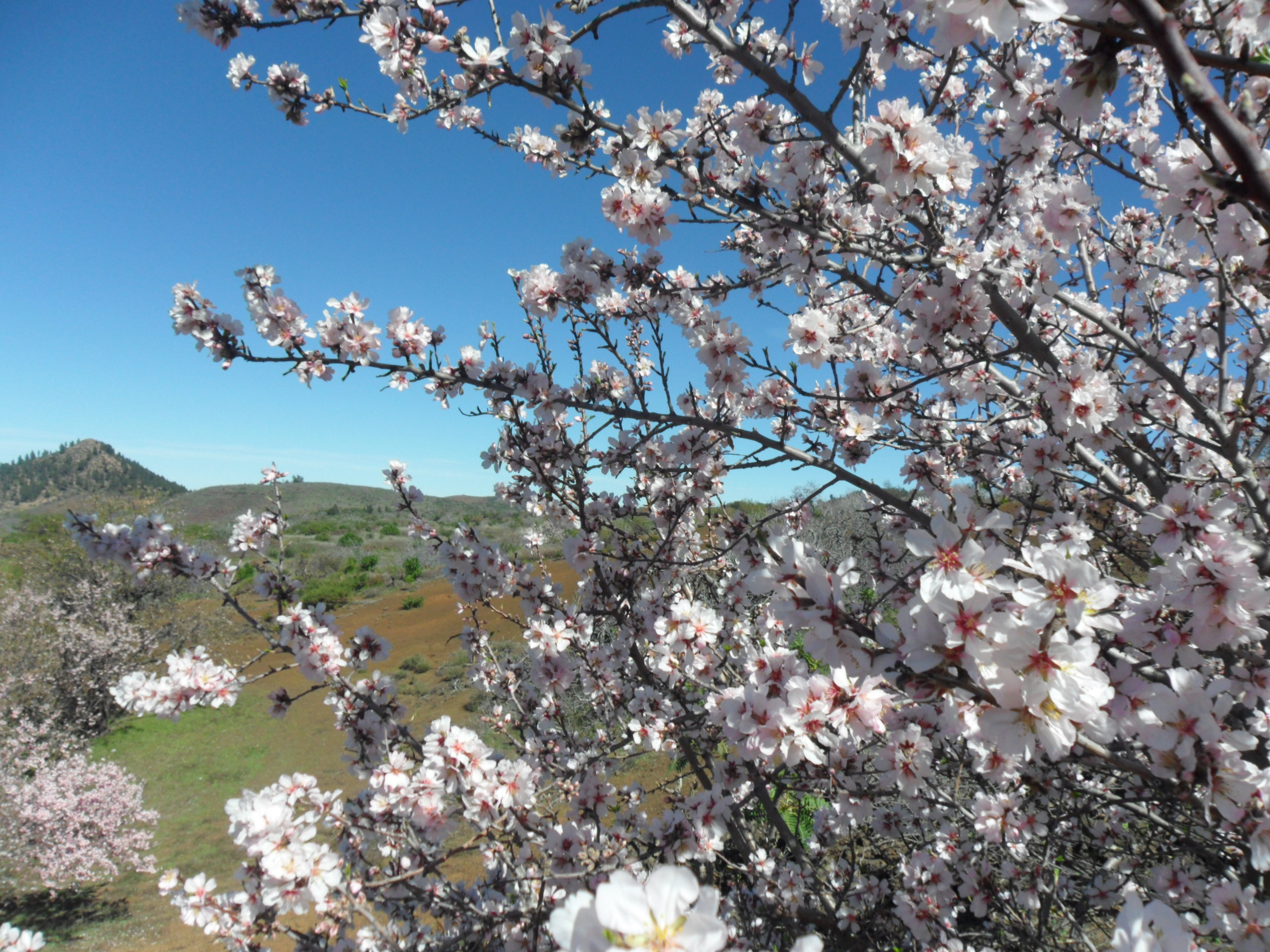
Twenty minutes up the road from Los Gigantes, at 900 metres, the village of Santiago del Teide spends most of the year being pleasantly overlooked. Then, somewhere between late January and mid-March, thousands of almond trees across the valley open at once — pink and white bloom against terraces of black volcanic rock — and the village hosts one of Tenerife’s most photogenic small traditions. It lands precisely in the low season, when flights and stays cost least, which makes it one of the best reasons on the island to book a winter week.
When the trees perform
Flowering runs from late January through early March, peaking in February, but the exact window moves with each winter’s temperature and rain, and a windy week can strip the petals early. Different corners of the valley also peak at different moments, which stretches the season for visitors. The reliable move: ring or drop by the village tourist office opposite the church (+34 922 86 03 48) and ask how the bloom is running before you drive up.
The blossom walk
The classic Ruta del Almendro en Flor leaves from the church square in Santiago del Teide and works its way through El Molledo and Las Manchas towards the pottery village of Arguayo: around eight to nine kilometres of well-signposted trail over agricultural terraces and old lava fields, moderate going, three to four hours. A shorter circular via Valle de Arriba takes about three and a half; the full one-way to Arguayo suits those happy to come back by bus (the tourist office keeps timetables). Park by the plaza, and carry water and sun protection — shade is scarce — then go midweek if you want the paths to yourselves, since the guided groups and markets all concentrate on weekends.
The February campaign
The village makes a month of it. The Campaña Almendro en Flor (the 29th edition ran from 24 January to 22 February 2026) wraps the bloom in guided Saturday walks — long, short, family, even a Valentine’s “lovers” route and an accessible seniors’ route — plus weekend agro-artisan markets on the plaza from 9:00 to 18:00, folklore evenings, and workshops on things like traditional truchas pastries and almond cocktails. Guided routes need advance booking through the town hall’s culture department and places are limited. A parallel Gastro-Ruta signs up village restaurants and cafés to serve almond-themed menus, tapas and breakfasts; ten took part in 2026, from La Casona del Patio down to the café in Arguayo. About a dozen shops stock almond sweets during the campaign: almendrados, almond torte, the little pastry parcels for a few euros. The 30th edition should run late January to late February 2027 — check santiagodelteide.es nearer the time.
Why almonds, and why the black rock
The two halves of the postcard have separate stories. The almonds arrived as economics: when the Canary cochineal-dye trade collapsed in the late nineteenth century, valley farmers turned to almond trees, and for generations the harvest was the main livelihood. The black backdrop came later. On 18 November 1909 the Chinyero volcano just above the valley produced Tenerife’s most recent eruption — ten days of lava that took no lives but left the young, dark malpaís the blossom now flowers against. A wayside shrine at Los Baldíos still marks where locals gathered to pray as the flow approached; they credit the prayer with stopping it.
Make a day of it
The blossom is the headline, but the valley fills a day without effort. A signposted trail links the village square to the circular path around the 1909 volcano itself, roughly 8 km and around three hours from the plaza, through pines and raw lava. At the far end of the long blossom route, the Cha Domitila pottery centre in Arguayo keeps the pre-Hispanic hand-shaping tradition alive; entry is free, and it closes on Mondays.
February is the one month the valley’s kitchens compete over almonds, though outside the Gastro-Ruta the village restaurants around the plaza are still worth the drive. For photographs, go early, while the light is low and the air clearest, and shoot the blossom against the dark lava rather than the sky.
Photo: Elimedina, CC BY-SA 4.0 (https://creativecommons.org/licenses/by-sa/4.0), via Wikimedia Commons