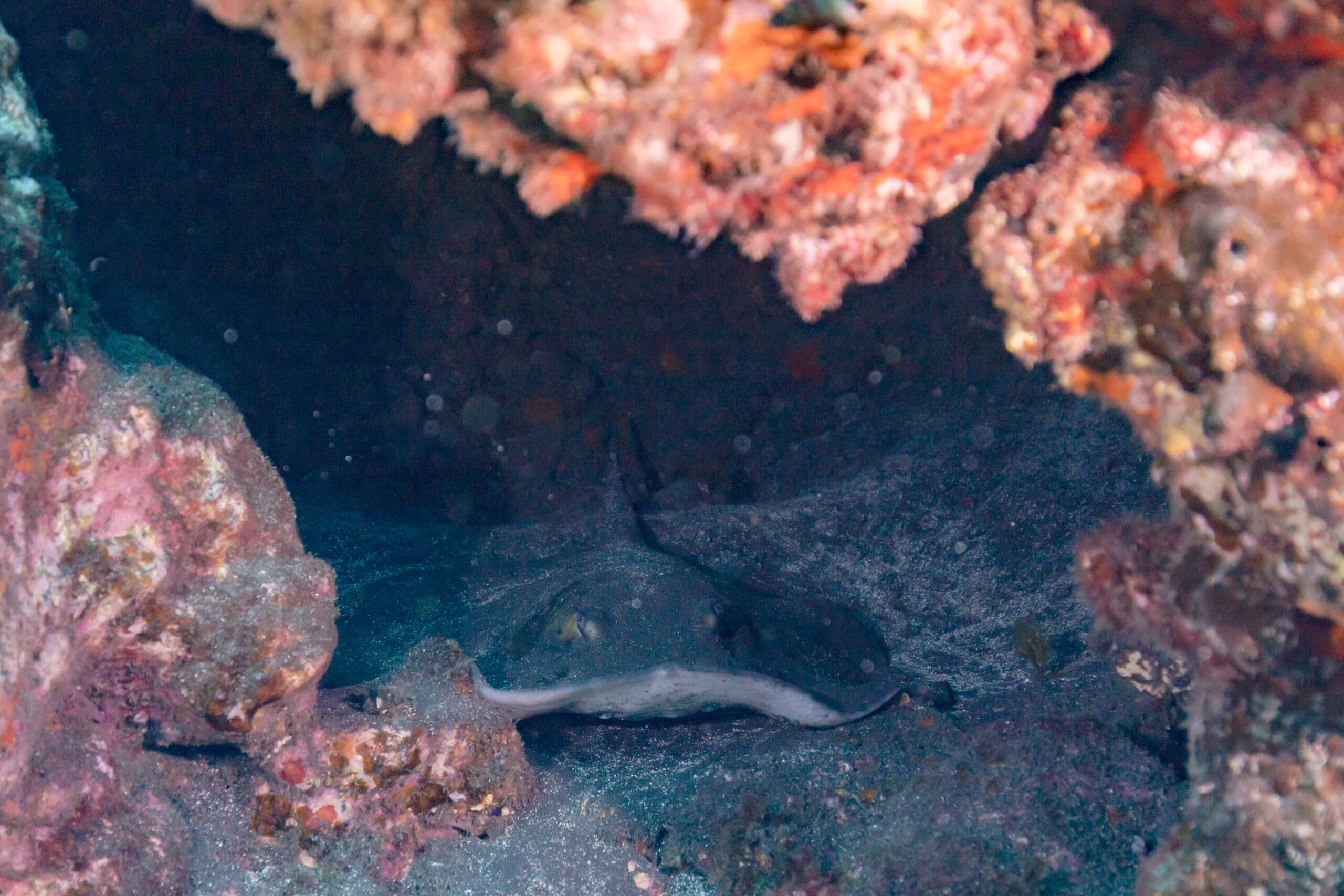
Underwater, Tenerife is the same volcano you have been looking at all week — lava arches, basalt columns and black-sand plains, patrolled by rays and wrapped in Atlantic blue. The whole coast off Los Gigantes lies inside the Franja Marina Teno-Rasca, a Natura 2000 protected strip of roughly 69,500 hectares that in 2021 became Europe’s first Whale Heritage Site. The water stays between 18 and 24 °C all year, so there is no off-season — just a winter wetsuit and a summer one. What follows covers the sites, the operators, the gear and the rules, as of July 2026.
Diving under the cliffs
There is no shore diving in Los Gigantes itself; everything goes by fast boat from the marina, and most sites are three to fifteen minutes away, right under the 500-metre walls. The local showpiece is Atlantis (16–30 m, for experienced divers): hexagonal basalt columns like a drowned Giant’s Causeway, with a cave at depth where a shoal of African grunts hangs in the dark. Barranco Seco Arch (5–18 m) suits every level — a volcanic archway dressed in red and yellow sponges, with stingrays so used to divers they practically pose. Octopus Cove (2–15 m) is the sheltered option, with a resident barracuda school and, in winter, angel sharks on the sand; Rolf’s Cave hides sleeping rays and Canarian spiny lobsters; and Lolita is a small fishing-boat wreck at 10–22 m. Depth figures are those published by the operating dive centre, so treat them as a rough guide.
A word about Isla Cangrejo, the lava islet by the marina, because the name confuses visitors. It is not a dive site. The natural pool at its foot is a swimming spot governed by closures and swell alerts, and after the December 2025 tragedy there you should treat any barrier or red flag as absolute.
What you will actually see
Rays are the west coast’s signature: common and round stingrays on the sand, eagle and butterfly rays cruising past, the occasional torpedo ray doing its best impression of a paving slab. Trumpetfish are everywhere, morays look out of every second crack, and barracuda school over the walls. The winter prize is the angel shark — a critically endangered flattened shark whose last global stronghold is the Canaries. From roughly November to April they rest on sand at diveable depths; keep two to three metres back, perfect your buoyancy and never touch; they are strictly protected. Green turtles live around the seagrass bays near Las Galletas and Palm-Mar rather than here; the famous “turtle bay” of El Puertito, up the coast in Adeje, lost most of its resident turtles years ago to crowding and illegal feeding, so do not book a dive on that promise. Dolphins and pilot whales are a boat-ride spectacle — seeing them on scuba is luck, not planning.
Shore classics around the island
The rest of the island has classics of its own. On the east coast, the Tabaiba wreck “El Peñón” is the old harbour tug Cepsa Segundo, scuttled as a reef in 2006, with the deck around 15–18 m and the seabed around 28–32 m. It is the island’s best easy wreck; advanced certification is the sensible minimum. Radazul is the classic training and night-dive bay, with paved stairs into a sheltered marina, and it is diveable nearly every day of the year.
Abades is a gentle bay over seagrass meadows inside another Natura 2000 site, with reefs from 3 m and a documented winter nursery for angel sharks. At Montaña Amarilla on the Costa del Silencio, a yellow tuff cone continues underwater as a lunar landscape of arches and swim-throughs at 5–18 m; watch the sharp lava on entry. Las Eras has tunnels and small caves around 12 m, then a wall for the experienced, with angel sharks on the sand in season. And Palm-Mar, reached by boat from the southern ports, pairs a sponge-covered wall under Montaña de Guaza with the deep Cueva de las Morenas, a moray-packed cave whose entrance sits around 27–33 m — advanced divers only, no penetration.
Who to dive with
Ratings and prices below are as published in July 2026 — check before you book. In Los Gigantes itself, the Los Gigantes Diving Centre in the marina gallery has run since 1990 and is both a PADI five-star centre and the area’s only BSAC school; a try dive is €85 and a two-dive boat trip €108–130 depending on kit. Its reviews split: 4.2 on TripAdvisor across roughly 190 reviews, a more modest 3.7 on Google across about 107. A few steps away in the Poblado Marinero, French-run Diving Angel is the SSI option; one directory shows a 5.0 Google rating from over 900 reviews (a figure we could not independently confirm), and a try dive is €90. In Playa San Juan, twenty minutes south, German-run PAMA Diving is a PADI five-star centre working the same protected strip.
Further south, Diving Atlantis in Los Cristianos carries the best-documented reputation on the island (4.8 from over 2,100 verified reviews on its aggregator, 4.9 on Google from around 2,500), with two boat dives at €90 and open-water courses from about €400. Ocean Trek (Costa Adeje) is the one that verifiably runs trips to Abades, Montaña Amarilla and Palm-Mar; Aqua-Marina (Las Américas) has held PADI five-star instructor-development status since 1999; and Dive Tenerife in Las Galletas shows a 5.0 on TripAdvisor from around 200 reviews. Never dived at all? Try dives across the island run €67–90 with everything included, and an open-water course €396–500 over three to four days. Children can start from age eight — Spanish law caps them at 6 m to age nine, rising in steps to adult limits at sixteen.
Gear: renting, buying, fixing
Every centre rents full kit, so you can arrive with nothing but swimwear and a logbook. Retail is thinner than the diving scene suggests — the resort strips have no dedicated dive shop, and buying happens further afield: Box-Fish in Costa del Silencio is the island’s biggest dedicated store (Cressi, Scubapro, Aqualung and the Canary distributor for Tecline; rated 4.7 from 130 reviews on ProvenExpert), Aquarius in El Fraile is an authorised Scubapro service point, and Scubanana at Radazul marina specialises in Aqualung and Apeks. For cylinder hydrostatic testing the answer is a trip north to La Laguna — no southern test station could be verified.
What Spanish diving law requires
Recreational diving in Spain is governed by Royal Decree 550/2020, and several of its rules surprise visitors:
- Insurance is mandatory — every diver needs accident and civil-liability cover that includes diving. Centres check it and sell day or week policies at the counter; DAN membership qualifies. Blogs claiming otherwise are wrong.
- A self-declaration health questionnaire is the medical default. No doctor’s certificate is needed unless you flag a condition; if you do, an annually renewed medical is required before you dive.
- The recreational depth ceiling is 40 m, air or nitrox, no planned decompression, whatever your certification card says.
- Solo diving is effectively illegal. The law defines the minimum dive unit as a buddy pair in the water, and agency solo certifications do not override it.
- Each buddy team must carry a surface marker buoy and a cutting device — sensible anyway in a busy whale-watching port.
- Spearfishing needs its own Canary licence and is only legal freediving; combining a speargun with scuba is prohibited.
If something goes wrong
Call 112 first (operators speak English), then the DAN Europe dive-emergency line (+39 06 4211 5685) for specialist advice. The archipelago’s hyperbaric chamber for diving accidents is at the Hospital Universitario de Canarias in La Laguna, about an hour and ten minutes from Los Gigantes by road; serious cases travel by 112 ambulance or helicopter rather than private car. Despite what some guides claim, no south-coast hospital had a dive-emergency chamber as of July 2026; the small chamber newly installed at a private Adeje clinic is for wound care rather than decompression sickness. Respect no-fly times: DAN advises at least 12 hours after a single dive and 18 after repetitive days, and the 3,555-metre drive or cable car up Teide deserves the same caution as a flight. The everyday injuries are humbler: weever fish buried in shore-entry sand and scorpionfish on the rock both sting painfully, and both venoms break down in hot water — immerse the limb at 42–45 °C and see a lifeguard or pharmacy, with 112 for anything beyond pain.
Water, seasons, suits
Expect 18–20 °C from December to March and 22–24 °C in summer, peaking around October; visibility usually runs 20–30 m. A 5 mm wetsuit is the year-round standard, with a 7 mm or a hooded vest welcome in midwinter and a 3 mm workable only in late summer. The south-west is the island’s sheltered flank, which is why Los Gigantes dives all year while the north coast takes the swell. The water will never pass for tropical, but for volcanic drama, winter angel sharks and rays at arm’s length, few places in Europe come close. And it starts three minutes from the marina.
Photo: Diego Delso, delso.photo, CC BY-SA 4.0 (https://creativecommons.org/licenses/by-sa/4.0), via Wikimedia Commons