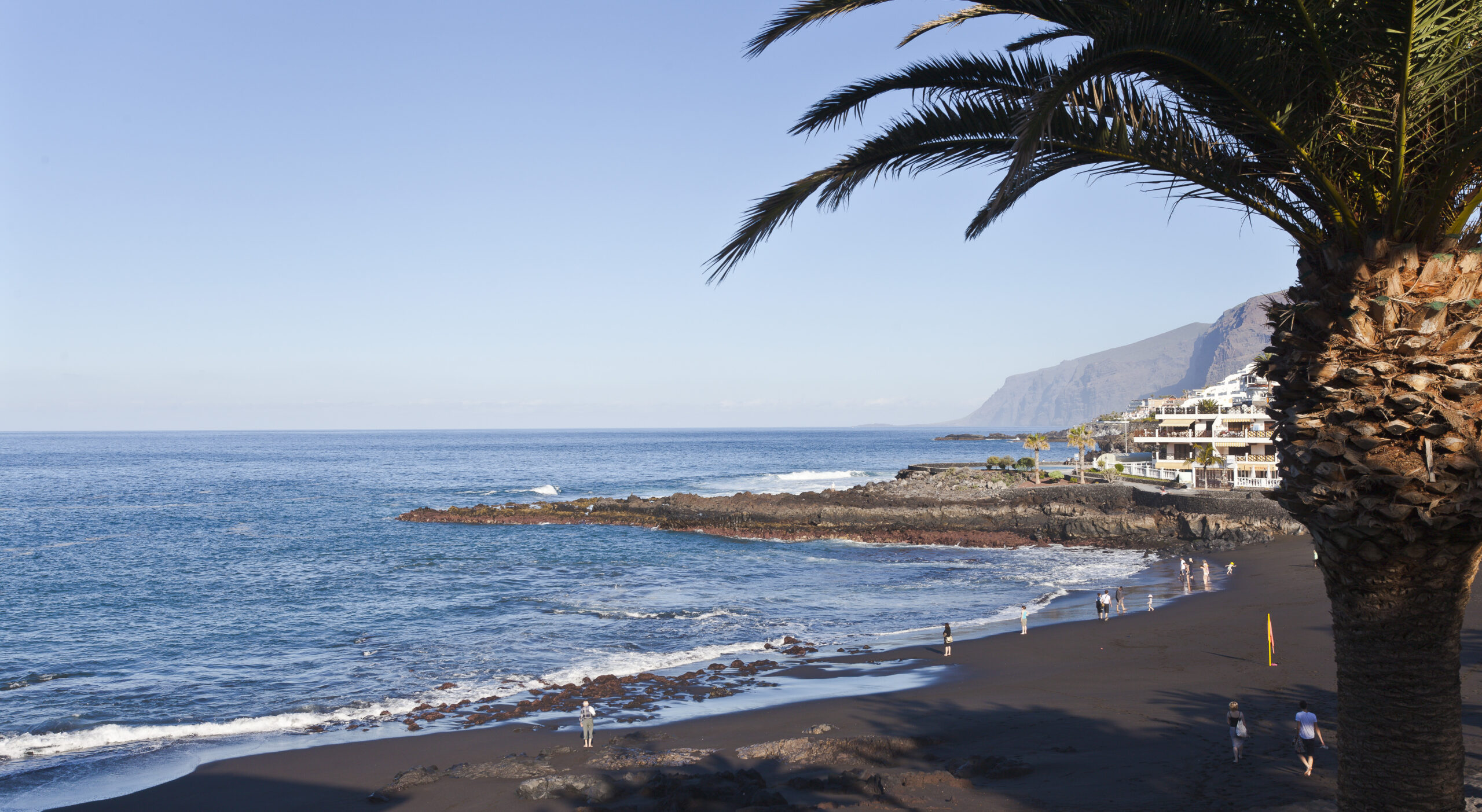
There is a species of visitor the Canaries have hosted for generations: the winter escapee, arriving in November and leaving when the almond blossom fades. Los Gigantes suits them unusually well — small, residential, warm and quiet, with enough going on to fill three months without a single visit to a theme park. This guide covers the practical side of a one-to-six-month winter stay, from paperwork to broadband, as researched in July 2026.
The winter-sun arithmetic
December to March on this coast runs at 21–23 °C by day with nights in the mid-teens, six to seven hours of sunshine daily and a sea that never drops below about 18–19 °C. That is brisk for a soak but fine for a swim, and the dive centres work straight through. Whale-watching boats sail from the marina every day of the winter, the hiking season is at its best, and February brings almond blossom in the valley and Carnival across the island. One expectation to set correctly: winter is the Canaries’ high season. Restaurants stay open, the promenade is lively, and nothing shuts for the off-season, because there is no off-season. The clock helps too. The Canaries share the UK–Ireland–Portugal time zone, one hour behind mainland Spain, which makes remote work for a British or Irish employer seamless.
Paperwork, by passport
EU and EEA citizens need nothing at all for stays up to three months: a passport or ID card and you are in. Beyond three months the official rule is registration as a resident. UK and other visa-exempt visitors get 90 days in any rolling 180-day window across the whole Schengen area — enough for a classic January–March escape but too short for an October-to-Easter one. Since April 2026 the border runs on the biometric Entry/Exit System rather than passport stamps, so the counting is automatic; the separate ETIAS travel authorisation had still not launched as of July 2026 (official guidance said late 2026, with press reports of a slip to 2027 — nothing to apply for yet, and any site selling it today is not official). For stays beyond the 90 days, Spain’s digital-nomad visa is the established route for remote workers: the income bar is set at twice the Spanish minimum wage, a 2026 figure that specialist advisers put around €2,850 a month, with health insurance and a clean criminal record among the requirements. Working remotely for a foreign employer during a short tourist stay sits in a legal grey zone that commentators describe as widely tolerated; the visa is the clean answer for anything longer.
Working from the cliffs
Connectivity stopped being the worry years ago: fibre reached Los Gigantes and Puerto de Santiago in 2017–18, official mid-2025 data puts fibre past nine in ten Tenerife homes at gigabit class, and 5G covers the town. Whether a specific building is connected is another matter; coverage checkers and your host know, so ask us about the apartment’s connection before booking a working stay. What the town does not have is a dedicated coworking space. The nearest work-focused spots locally are hotel and hostel work areas (the Arena Nest hostel in Puerto de Santiago keeps one), with proper coworking about half an hour away in Costa Adeje and a coworking-coliving scene in Los Cristianos. Most winter remote workers here simply work from the apartment and take the promenade as their commute.
What it costs to live here
Day-to-day living is kinder than northern Europe: the Canaries run a 7 per cent local sales tax against the mainland’s 21 per cent VAT, industry surveys put the region’s fixed-price weekday lunch (menú del día) around €13, the cheapest in Spain, and crowd-sourced comparisons rate London roughly 60 per cent more expensive than the Tenerife capital before rent. The rent is the catch. Winter is peak season, long-let stock is scarce, and most one-bedroom apartments in the Los Gigantes–Puerto de Santiago area were advertising at roughly €850–1,300 a month in mid-2026, with agencies preferring six-month terms and shorter winter stays priced as holiday lets. There is no clever fix beyond booking months ahead and asking directly — our own apartments take long winter bookings, and we would rather host one good guest for a season than juggle twelve changeovers.
The no-heating quirk
Around nine in ten homes in this province have no heating system, because for eleven months a year none is needed — a fact that genuinely surprises first-time winterers. Buildings are designed to shed heat, not hold it, so on a 15-degree January evening the living room can feel cooler than the number suggests. The local solutions are a plug-in heater, a blanket on the sofa and a warmer layer after sunset, plus an acceptance that electricity bills run higher in winter than summer. Pack one jumper more than the brochure implies; you will wear it on the terrace at ten o’clock.
Settling in
You will not winter alone: just over half of the municipality’s registered residents were born abroad (51.5 per cent in the 2024 census figures), and Los Gigantes has been an international enclave since the resort was laid out in the 1960s, with a long-standing British thread — there is an English-speaking Anglican congregation at the church on Plaza Bougainvillea and an active Lions Club charity running its second-hand shop for good causes. For structure, the municipal sports complex in Puerto de Santiago offers padel, tennis, a gym and Pilates classes at local prices; guided walking outfits run English-language hikes all winter; and the healthcare basics sit close by — a public health centre in Puerto de Santiago, pharmacies with a night-duty rotation, and the southern hospitals within forty minutes (our healthcare guide covers the details). The remaining winter cautions are in our weather guide: swell days, the odd calima, occasional snow closures on the Teide road. None of them changes the arithmetic; they are simply worth knowing before you commit to a season.
Photo: Diego Delso, delso.photo, CC BY-SA 3.0 (https://creativecommons.org/licenses/by-sa/3.0), via Wikimedia Commons