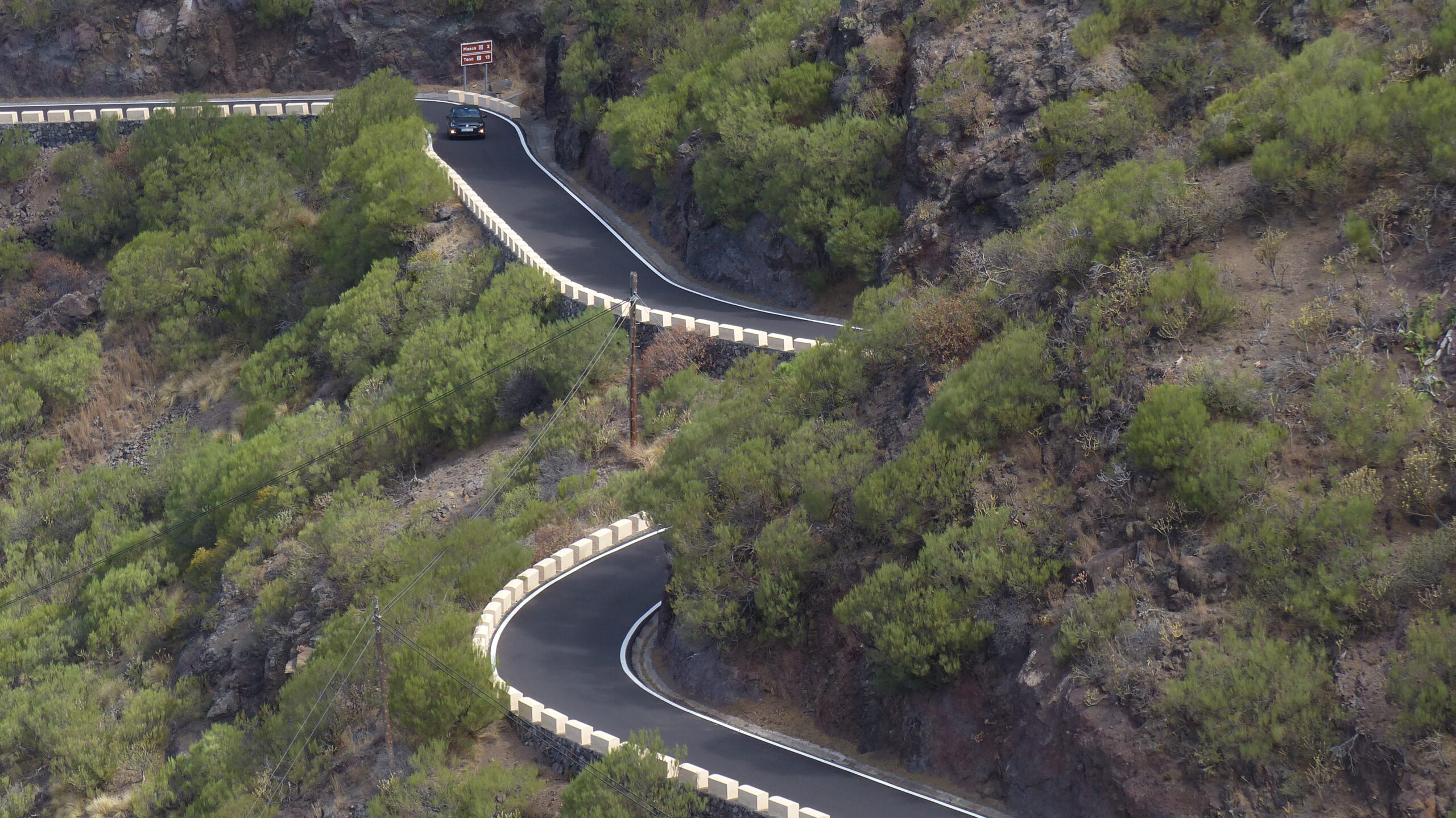
A car is the key that unlocks this island: Teide, Masca, the north coast and the quiet villages all sit at the end of roads the buses barely serve. The driving itself is easier than the hairpin photographs suggest, but Tenerife has its own rules, habits and hazards, and a few of them changed recently. Everything below is as of July 2026.
Renting: the Canarian model
The pleasant surprise for most visitors is the local rental model. The two big Canarian firms, CICAR and Autoreisen, sell all-in prices with fully comprehensive, zero-excess insurance included — no deposit block on your card beyond fuel, no queue-side upselling — plus free child seats, free second driver and unlimited mileage. It is a different world from the deposit-and-excess machinery of some international brands, and it is why locals recommend them by reflex. Two practical notes. Automatics are still the minority in Spanish fleets, so book one early if you need it (and on the hairpins you may be glad of it). And children under 135 cm must ride in the back in an approved seat — the firms lend seats free, but you fit them yourself.
Rules that catch visitors out
- Roundabouts are the big one. In Spain you exit from the outside lane; the inner lane is only for circulating, and you merge out before your exit — never cut across from the middle. Expect local drivers to lap the outside lane the whole way round; that is the convention, not bad driving.
- Alcohol: the limit is 0.5 g/l of blood (0.25 mg/l breath), which is roughly one small drink, and a stricter national limit keeps returning to parliament — the last attempt was voted down in March 2026. At these gradients the simplest policy is to drink nothing at all before driving.
- Merely holding a phone while driving costs €200 and six points.
- The V-16 beacon: since 1 January 2026, Spanish-registered cars — hire cars included — must carry a connected V-16 emergency beacon instead of warning triangles. Supplying it is the rental firm’s job; checking it is in the glovebox at pickup is a ten-second habit worth having.
- Cyclists must be given at least 1.5 metres of clearance and a lower passing speed, changing lane fully to overtake where there are two. This island trains professional pelotons all winter, so you will meet them on the mountain roads.
- Speed defaults — 120 on the motorways, 90 on open roads, 50 in town and 30 on single-lane urban streets. Fixed cameras sit on the TF-1 and TF-5 and five more arrived across the island in 2025. Fines follow a hire car home: the rental firm charges an admin fee and passes your details on, and paying within 20 days halves the fine.
Mountain roads without drama
The famous one is the TF-436 to Masca: hundreds of bends in 22 km, sections too narrow for two cars, and scheduled buses that need the full width of every hairpin. The technique is patience. Wait in a pull-in when you see a coach coming, follow the driver’s hand signals, and know the rule for narrow gradients: the car heading uphill has priority, and the descending car reverses to the passing place. Take the smallest car you are comfortable in, go early in the morning, and rather than turning around at Masca, continue north to Buenavista, where the road relaxes. A short beep before blind bends is local convention. On the long descents from Teide, use a low gear and let the engine do the braking — riding the brake pedal for 1,500 vertical metres is how brakes fade. And around every viewpoint, expect the island’s most predictable hazard: cars stopped mid-road for a photograph.
Weather on the road
Three local phenomena are worth knowing. During a calima, Saharan dust cuts visibility: lights on, speed down, bigger gaps. The cloud belt sits at roughly 600–1,200 metres on the north side, so routes to Teide from that flank punch through a fog layer. Sunny below, sunny above, fifty metres of visibility in between — normal, brief, and no reason to brake sharply. And in the rare heavy rain, respect closed-road signs in the barrancos; those dips flood fast. In winter, snow occasionally closes the Teide roads entirely, so check the Cabildo’s road information or dial 012 before driving up.
Parking, fuel and the boring essentials
The kerb colour code: white is free, blue is normally pay-and-display (though here in Santiago del Teide municipality the blue bays are free and simply time-limited — a local quirk worth enjoying), and yellow means no parking at all. Wherever you stop at a trailhead or viewpoint, take everything with you and leave the car visibly empty, because break-ins targeting obvious hire cars are a documented nuisance at popular car parks. Fuel is one of the island’s bargains: roughly a euro to €1.35 a litre in mid-2026, far below mainland prices, with the low-cost and local chains cheapest and the south generally cheaper than the north. Small rural stations keep short hours, so do not set off for Teide or Teno on fumes — fill up in Tamaimo or Chío on the way.
Photo: Benjamín Núñez González, CC BY-SA 4.0 (https://creativecommons.org/licenses/by-sa/4.0), via Wikimedia Commons