The island you watch the sun set behind every evening is closer than it looks. From Los Gigantes it is thirty-five minutes down the coast to Los Cristianos harbour, then a fifty-minute ferry across the channel to San Sebastián de La Gomera — and the crossing itself runs straight through the waters of Europe’s first Whale Heritage Site, so claim a spot on deck and watch for pilot whales on the way. What follows is the day-trip playbook, with schedules and prices as checked in July 2026 — both change with the season, so reconfirm for your date.
The ferries
Two operators, Fred. Olsen Express and Naviera Armas, run up to eight fast crossings a day between them. On weekdays the workable pattern is out at 09:15–09:30 and back on the last sailings at 17:00–17:30, which buys you six and a half to seven hours ashore; Sundays stretch the day, with final returns around 20:00–20:30. A foot-passenger return runs about €85–90; taking a car adds very roughly €50–150 each way depending on date and demand. Book ahead in summer and arrive early — boarding queues can be slow. One piece of trivia for the crossing: Fred. Olsen’s Benchijigua Express was, at delivery, the largest trimaran ferry ever built, and the hull design of the US Navy’s Independence-class warships descends from it. You are commuting on naval architecture.
Car, coach or on foot
To see the forest you need wheels. The straightforward option is renting on La Gomera: CICAR has offices at the San Sebastián port, but the fleet genuinely sells out in high season, so book when you book the ferry. Taking your Tenerife hire car across is possible only with the right company: CICAR permits it with prior notice; with other firms assume no unless you hold written confirmation. The zero-effort alternative is an organised day tour from Tenerife (around €100–115 including ferry, coach, guide, lunch and a whistling demonstration), though pickups concentrate on the southern resorts, so check whether Los Gigantes is served or drive yourself to the port. And if you would rather not plan at all, San Sebastián alone fills a relaxed half-day on foot.
One day, one loop — do not try to see it all
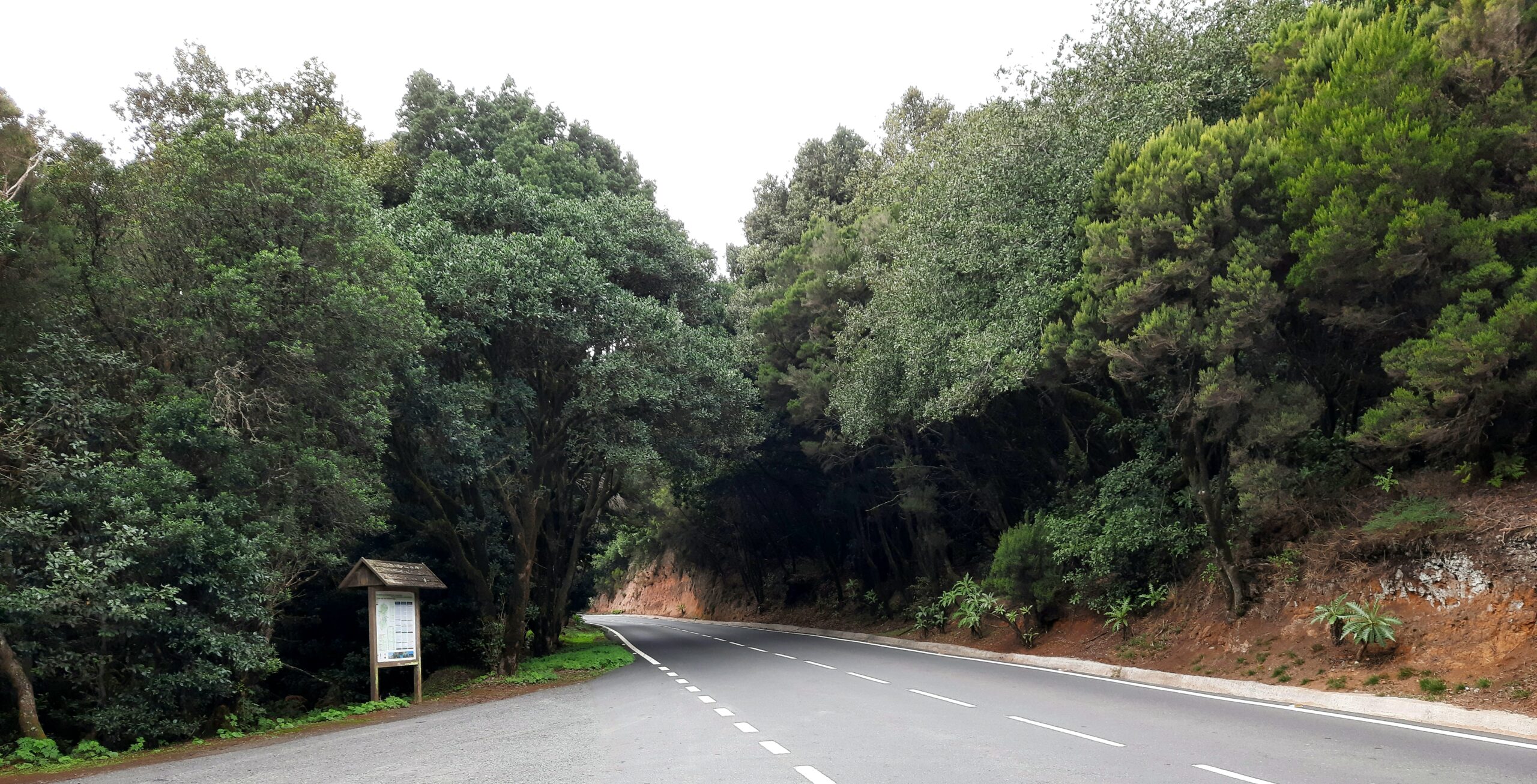
La Gomera’s distances deceive: the roads coil through ravines and 25 km can take fifty minutes, so a single day supports one loop, done well. The classic version climbs the GM-2 to the Degollada de Peraza viewpoint, pauses below the rock monolith of Roque de Agando, then heads into Garajonay National Park — a UNESCO World Heritage Site since 1986, preserving the finest surviving laurel cloud-forest on Earth, a green relic of the subtropical woods that covered southern Europe millions of years ago. Walk the short summit trail to Alto de Garajonay (1,487 m, the island’s highest point) or the easy circuit at Laguna Grande, where there is also a restaurant among the trees, then wind back down for the evening boat. The alternative loop heads north instead — Agulo’s old town, the glass skywalk at Mirador de Abrante hanging 200 metres over the village, and the Juego de Bolas visitor centre. Valle Gran Rey, the famous western valley, is the thing to leave for another trip: it sits at the far end of the island and eats the whole day in driving.
The whistling island
Silbo Gomero, the island’s whistled language, turns whole Spanish sentences into whistles that carry for kilometres across the ravines — UNESCO listed it as Intangible Cultural Heritage in 2009, and every Gomeran child has learned it at school since 1999, a rescue few endangered languages ever get. The reliable places to hear it are the Mirador de Abrante and Restaurante Las Rosas near Agulo, where whistlers demonstrate over lunch — both cater heavily to tour groups, so independent visitors should call ahead or ask about times on arrival.
San Sebastián on foot
The little capital wears its history lightly. This was Christopher Columbus’s final port of call: his fleet sailed from here on 6 September 1492 into the unknown, and the town has styled itself the Isla Colombina ever since. The Torre del Conde (1450s) is the oldest surviving fortification in the Canaries; the Casa de Colón, where the navigator is said to have lodged, hosts a small exhibition; and the well in the old customs house bears the confident plaque that “with this water America was baptised” — tradition rather than court-proof documentation, and better for it. Round it off at Playa de la Cueva, the town beach by the harbour, with Teide filling the horizon across the water. The view alone justifies the ticket.
Eat it, then pack it
Two tastes are the island’s own. Almogrote is a fierce, spreadable paste of cured goat’s cheese, peppers and garlic — order it on toasted bread anywhere, then buy artisan jars at the San Sebastián market before the evening boat. Miel de palma is not honey at all but palm sap reduced to a dark, smoky syrup; drizzle it over cheese or desserts and you will want a bottle for home. Both travel well in hand luggage back across the channel.
Practical notes
Pack a layer, because the summits sit in the trade-wind cloud, and that cool mist is precisely what waters the laurel forest; sunny coasts and foggy heights on the same day are normal. Fuel up in San Sebastián before climbing, since stations are scarce inland and most close on Sundays, and download offline maps rather than counting on phone signal in the barrancos.
One last timing note. Missing the last ferry means a night on the island — pleasant, but unplanned. Build in an hour of slack; the drive back to the port always takes longer than the map says.
Photo: Bybbisch94, Christian Gebhardt, CC BY-SA 4.0 (https://creativecommons.org/licenses/by-sa/4.0), via Wikimedia Commons