Step off the pavement anywhere around Los Gigantes and you are in the cardonal-tabaibal — the candelabra-cactus scrub that clothes Tenerife’s sun-baked lower slopes. It looks half-desert; it is actually a botanical garden of species that exist nowhere outside these islands.
Plants you will actually meet
- Cardón and tabaiba — the sculptural succulents on every slope between town and Punta de Teno. Admire, don’t touch: cardón’s white latex is caustic.
- The Canary Island pine is the fire-adapted giant of the uplands: thick bark, and it resprouts green from blackened trunks (the slopes around Chinyero show it beautifully). Its long needles literally comb water from the cloud sea.
- Icod’s famous dragon tree, the Drago Milenario, is “thousand-year-old” by name; because dragon trees form no growth rings, science can only bracket it at roughly 400 to 1,000 years. Several centuries, at minimum, of quiet judgement.
- Tajinaste, a note before you go: the metre-high crimson spires on postcards (Echium wildpretii) grow up in Teide National Park, blooming roughly mid-May to June, and are strictly protected. Around Teno you’ll meet their shrubbier blue and white cousins on spring ridges instead.
- Laurisilva — above Erjos, the Monte del Agua laurel forest is a surviving fragment of the subtropical woodland that covered the Mediterranean millions of years ago: permanent shade, moss, and endemic pigeons.
Animals, from the wall to the cliff face
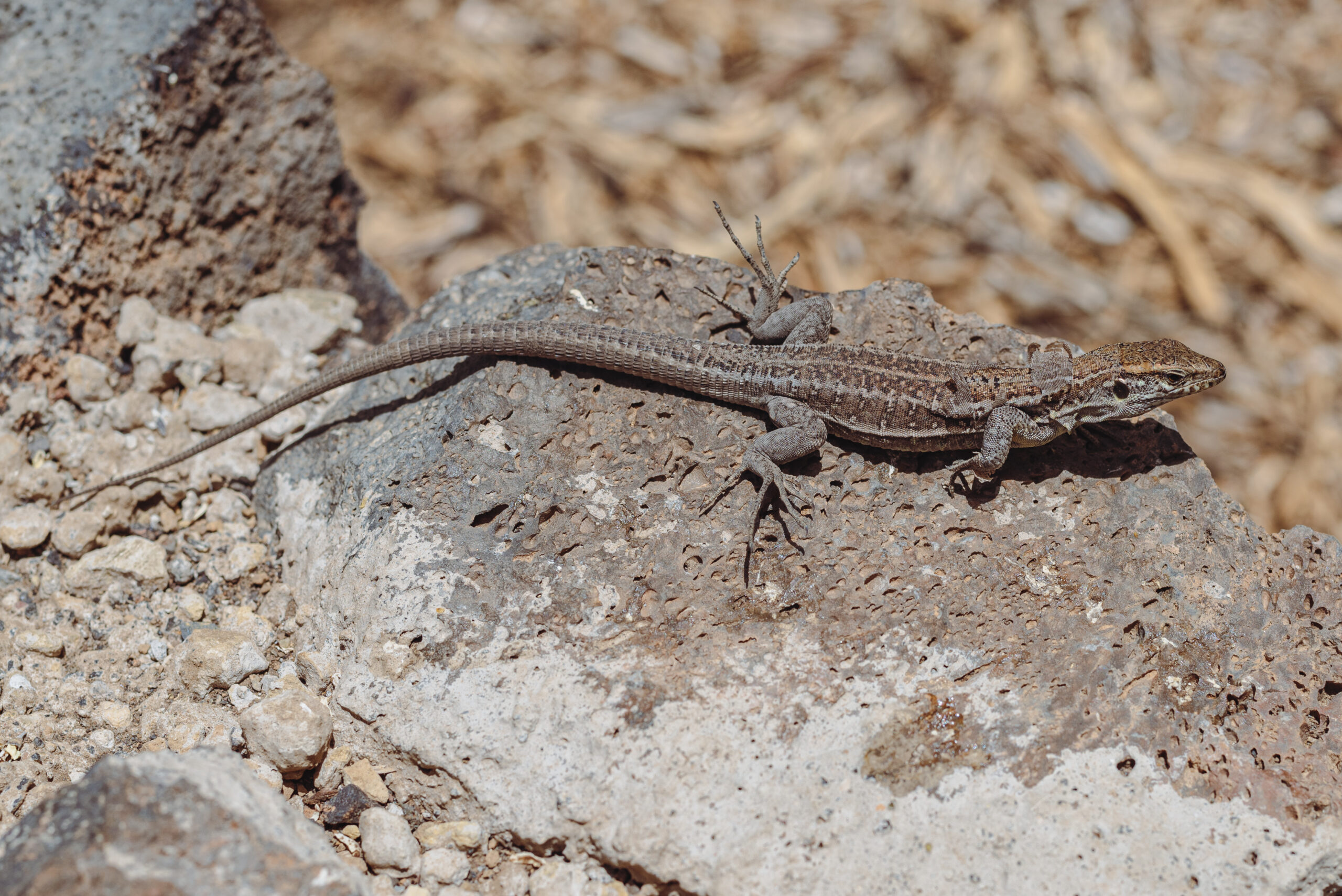
The Tenerife lizard is everywhere — males flash blue spots along their flanks — and endemic geckos patrol villa walls after dark. Kestrels hover over every barranco; ravens and Barbary falcons work the Teno ridges. Two stories deserve telling. First, the cliffs you look at every day hide a ghost: the Tenerife giant lizard, believed extinct until its rediscovery in 1996, survives on inaccessible Teno ledges; you will not see one, and that is rather the point. Second, these same cliffs are the island stronghold of the osprey: park-project reports counted only around six breeding pairs across the whole archipelago, and celebrated a chick fledging here in 2025 — the first since 2022. If a big white-bellied raptor plunge-dives for fish beside your boat trip, you have won the wildlife lottery.
Listen, too, on summer nights: the eerie wailing over the town is Cory’s shearwaters returning to cliff colonies. When the chicks fledge in late October and November, some are grounded by street lights — the islands run an annual rescue campaign, and the drill is simple: ventilated box, call 112, never release a bird at night near lights. And yes, the wild canary is genuinely wild here, dull green-yellow, nothing like its cage-bred cousins, singing in the greener valleys. Offshore, the Teno–Rasca marine strip is Europe’s first certified Whale Heritage Site, with a resident pilot-whale population estimated in the hundreds.
Seeing it — and the rules
The Mirador de Archipenque above town gives the cliff panorama with kestrels for company; La Cruz de Hilda overlooks the Masca ravine with a café terrace. Two access notes as of 2026: the old cliff-base walk at Barranco Seco is officially closed for rockfall danger, and Punta de Teno lighthouse is reachable only by the local bus during roadworks. Everywhere: collecting plants, rocks or sand is fined (commonly €600–1,500), and recreational drones are effectively off-limits across Teno, Chinyero and the Masca gorge; check the official maps before you pack one.
Photo: Flocci Nivis, CC BY 4.0, via Wikimedia Commons