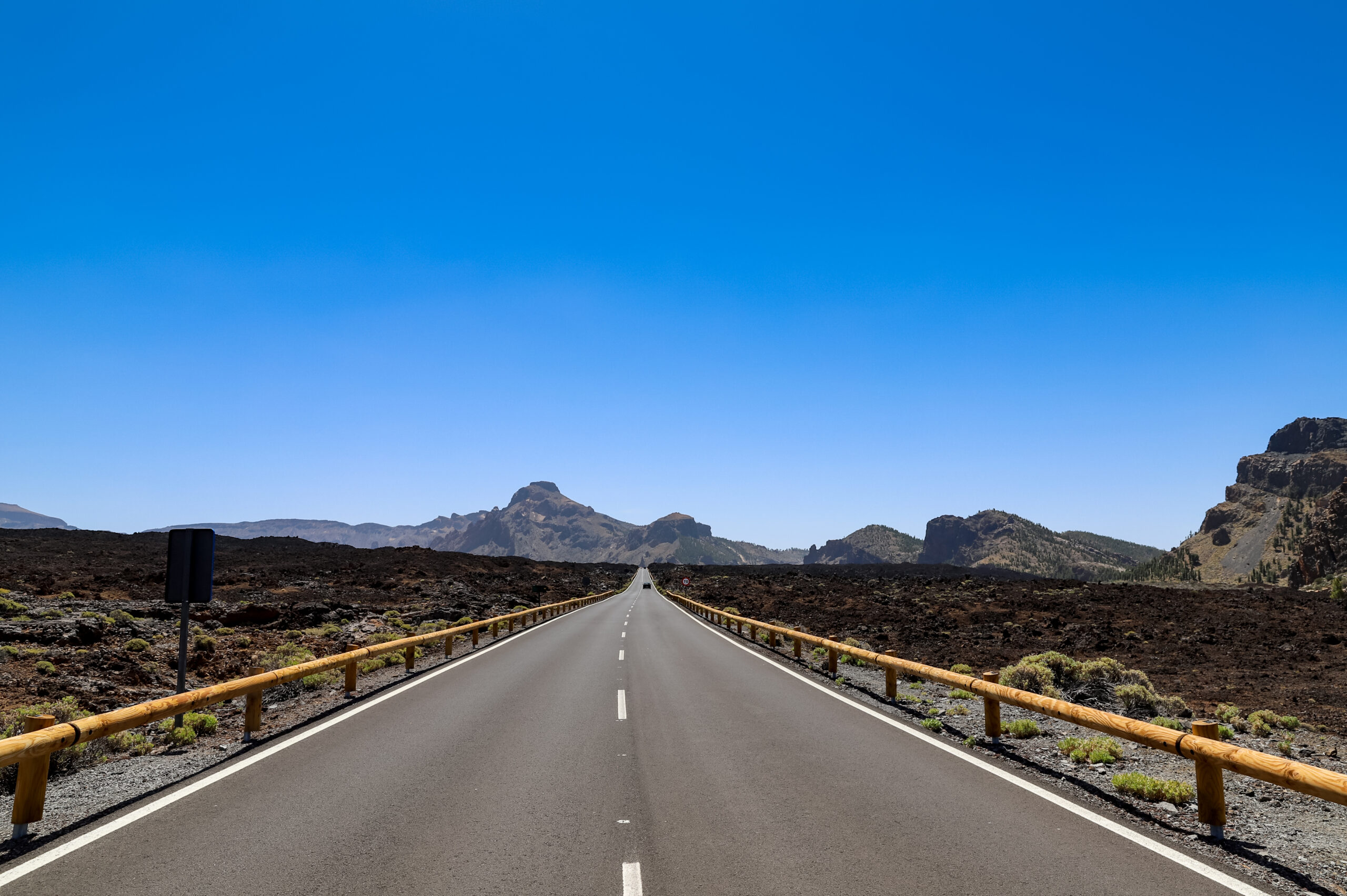
Every winter, while the Alps are under snow, a noticeable share of the professional peloton moves into a hotel at 2,152 metres inside Teide National Park. Team Sky brought Chris Froome here before the 2015 Tour; Visma have run Vingegaard’s altitude blocks here; in early 2026 Remco Evenepoel came for a post-race camp and found the Parador so booked out by teams that his squad took an apartment instead (in March the local press enjoyed reporting him briefly snowed in). The reason is simple: nowhere else in Europe offers a stable winter climate, empty roads and a continuous climb from the sea to over 2,000 metres. And the quietest way up the volcano starts from our side of the island.
The Chío road: the connoisseur’s Teide
From Los Gigantes harbour the climb to the crater rim via Chío measures out at roughly 37–40 km with around 1,700–2,100 m of gain depending on where you stop counting — sea level to the TF-38’s high point above 2,000 m at a steady 5–6 per cent, on good tarmac with long straights and barely a hairpin. Climbing sites rate it hors catégorie, and cycling writers rate the western approach the quietest of the four roads up, which is exactly what you want for a four-hour effort. Teide from the coast is among Europe’s longest road climbs in any direction — the full approach from Santa Cruz is widely cited as the continent’s longest. Logistics are part of the challenge, so fill both bottles in Chío (Bar Parada is the riders’ stop), because there is effectively nothing else until the caldera.
Masca and the middle-mountain loops
The other famous name is Masca — short and brutal where Chío is long and steady. From the Buenavista side it is about 5 km at 10 per cent average with ramps past 16; climbing out of the village itself is the island’s hardest few kilometres, on a narrow road shared with coaches (ride it early). The full loop from the coast — up through Santiago del Teide, down through Masca, around by Buenavista and back — runs about 74 km with over 2,100 m of climbing and is many visitors’ ride of the trip. Gentler days exist too. The climb to Santiago del Teide from Tamaimo is a steady categorised warm-up, and the Erjos pass (around 1,100 m) opens a fine circuit over to the north coast and back.
Bikes without the bike box
You do not need to fly your own machine. KUDO Rent in Puerto de Santiago (effectively on the doorstep) rents carbon road bikes from Shimano 105 to Di2, plus gravel bikes and e-road machines, with delivery to your apartment the evening before and free route files; its reviews run strongly positive. The established south-coast fleets deliver this far too: Free Motion publishes carbon road rates from about €21 to €42 a day (top-end race bikes more) and e-road bikes at €36–55, and Bike Point Tenerife runs a well-regarded road fleet from Las Américas. Rates are as published in July 2026 — book days ahead in the winter training season, when the good bikes go the way of the Parador’s rooms.
The rules and the real risks
Spanish law is friendlier to cyclists than most: drivers must give at least 1.5 metres and slow down to pass, crossing a solid line to do it if needed. In return, a helmet is mandatory on interurban roads — which is every road in this post — plus lights and reflective visibility in the dark, no headphones in both ears, and the drink-driving limit applies on two wheels as well. The genuine hazards are meteorological. Count on the summit road being 10–15 °C colder than the coast, more in windchill, with the cloud band between 1,000 and 1,800 m capable of sitting near zero in winter. Carry arm warmers and a shell for the half-hour descent even when the harbour is at 24 °C, and skip the big efforts on calima days, when the air fills with Saharan dust. Keep some judgement in reserve for the way down too: it is 35 km of descending, and the bends demand attention the whole way.
Ride it with numbers on
If you want the event experience, the Vuelta al Teide granfondo each May turns the island’s climbs into a timed day out — the 2026 edition drew over a thousand riders from 32 countries to a 182 km course with 4,600 m of climbing, with shorter 86 km and 64 km options for the sane (dates at vteide.com). Professional racing has been rarer than you would guess: the Vuelta a España has visited Tenerife exactly once, in 1988, and Teide has never hosted a Grand Tour summit finish — though the island’s government keeps bidding to change that. Until then, the mountain belongs to whoever climbs it, and in the morning quiet on the Chío road that will mostly be you, the pines and the occasional passing WorldTour train.
Photo: dronepicr, CC BY 2.0 (https://creativecommons.org/licenses/by/2.0), via Wikimedia Commons