Los Gigantes Vacation Rentals

Category: Uncategorized

  • Scuba diving in Tenerife: volcanic walls, rays and winter angel sharks

    Scuba diving in Tenerife: volcanic walls, rays and winter angel sharks

    Underwater, Tenerife is the same volcano you have been looking at all week — lava arches, basalt columns and black-sand plains, patrolled by rays and wrapped in Atlantic blue. The whole coast off Los Gigantes lies inside the Franja Marina Teno-Rasca, a Natura 2000 protected strip of roughly 69,500 hectares that in 2021 became Europe’s first Whale Heritage Site. The water stays between 18 and 24 °C all year, so there is no off-season — just a winter wetsuit and a summer one. What follows covers the sites, the operators, the gear and the rules, as of July 2026.

    Diving under the cliffs

    There is no shore diving in Los Gigantes itself; everything goes by fast boat from the marina, and most sites are three to fifteen minutes away, right under the 500-metre walls. The local showpiece is Atlantis (16–30 m, for experienced divers): hexagonal basalt columns like a drowned Giant’s Causeway, with a cave at depth where a shoal of African grunts hangs in the dark. Barranco Seco Arch (5–18 m) suits every level — a volcanic archway dressed in red and yellow sponges, with stingrays so used to divers they practically pose. Octopus Cove (2–15 m) is the sheltered option, with a resident barracuda school and, in winter, angel sharks on the sand; Rolf’s Cave hides sleeping rays and Canarian spiny lobsters; and Lolita is a small fishing-boat wreck at 10–22 m. Depth figures are those published by the operating dive centre, so treat them as a rough guide.

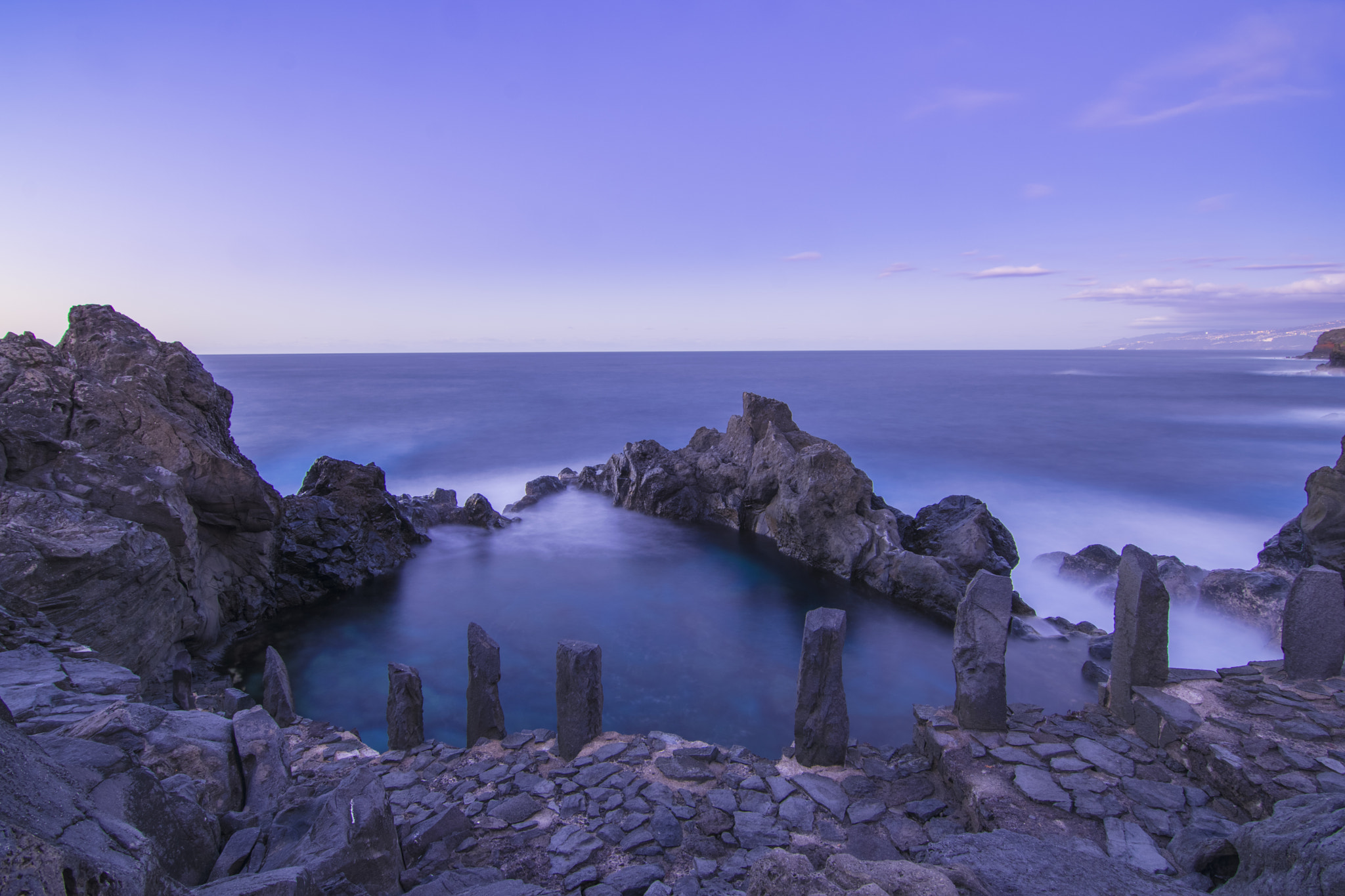
    A word about Isla Cangrejo, the lava islet by the marina, because the name confuses visitors. It is not a dive site. The natural pool at its foot is a swimming spot governed by closures and swell alerts, and after the December 2025 tragedy there you should treat any barrier or red flag as absolute.

    What you will actually see

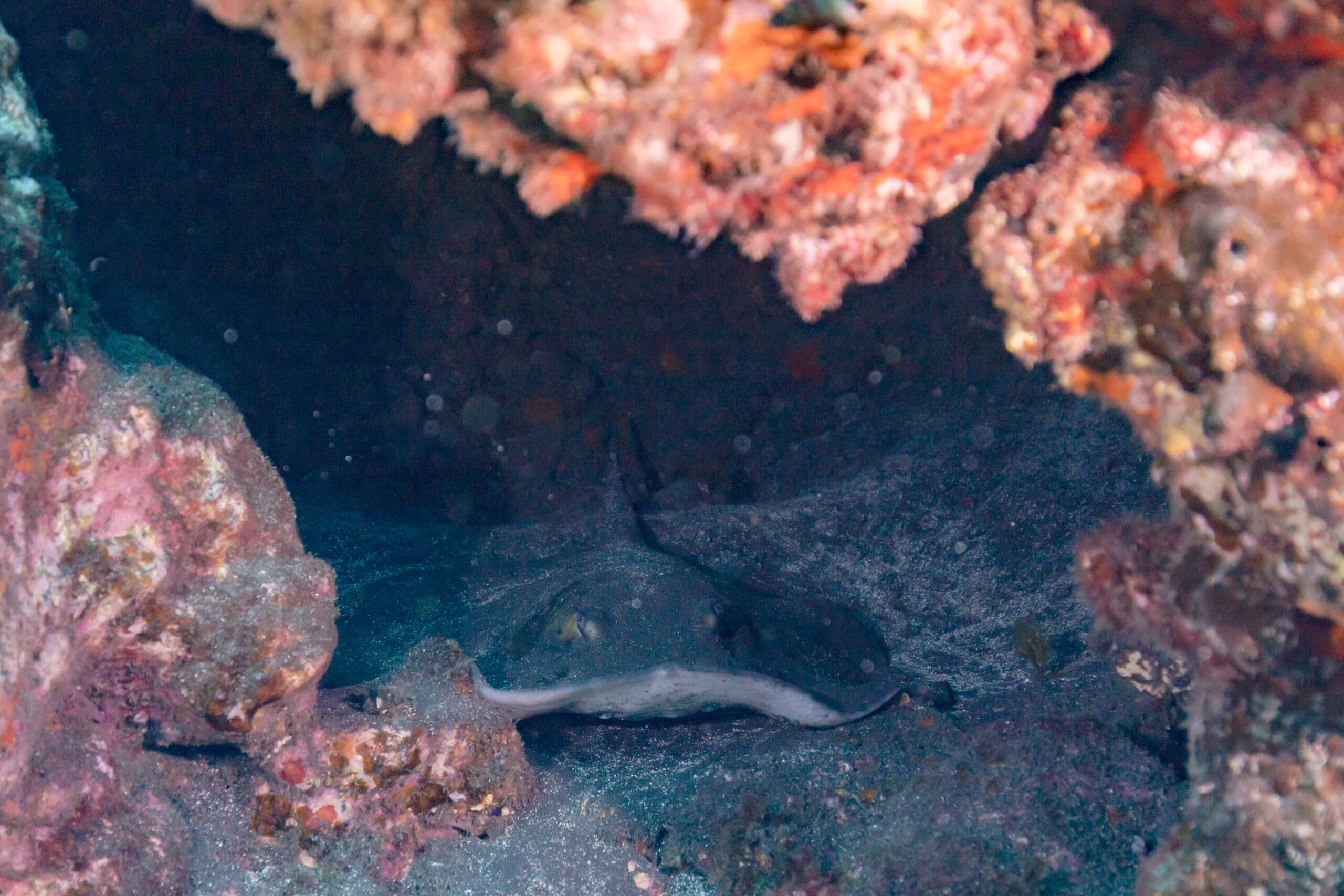
    Rays are the west coast’s signature: common and round stingrays on the sand, eagle and butterfly rays cruising past, the occasional torpedo ray doing its best impression of a paving slab. Trumpetfish are everywhere, morays look out of every second crack, and barracuda school over the walls. The winter prize is the angel shark — a critically endangered flattened shark whose last global stronghold is the Canaries. From roughly November to April they rest on sand at diveable depths; keep two to three metres back, perfect your buoyancy and never touch; they are strictly protected. Green turtles live around the seagrass bays near Las Galletas and Palm-Mar rather than here; the famous “turtle bay” of El Puertito, up the coast in Adeje, lost most of its resident turtles years ago to crowding and illegal feeding, so do not book a dive on that promise. Dolphins and pilot whales are a boat-ride spectacle — seeing them on scuba is luck, not planning.

    Shore classics around the island

    The rest of the island has classics of its own. On the east coast, the Tabaiba wreck “El Peñón” is the old harbour tug Cepsa Segundo, scuttled as a reef in 2006, with the deck around 15–18 m and the seabed around 28–32 m. It is the island’s best easy wreck; advanced certification is the sensible minimum. Radazul is the classic training and night-dive bay, with paved stairs into a sheltered marina, and it is diveable nearly every day of the year.

    Abades is a gentle bay over seagrass meadows inside another Natura 2000 site, with reefs from 3 m and a documented winter nursery for angel sharks. At Montaña Amarilla on the Costa del Silencio, a yellow tuff cone continues underwater as a lunar landscape of arches and swim-throughs at 5–18 m; watch the sharp lava on entry. Las Eras has tunnels and small caves around 12 m, then a wall for the experienced, with angel sharks on the sand in season. And Palm-Mar, reached by boat from the southern ports, pairs a sponge-covered wall under Montaña de Guaza with the deep Cueva de las Morenas, a moray-packed cave whose entrance sits around 27–33 m — advanced divers only, no penetration.

    Who to dive with

    Ratings and prices below are as published in July 2026 — check before you book. In Los Gigantes itself, the Los Gigantes Diving Centre in the marina gallery has run since 1990 and is both a PADI five-star centre and the area’s only BSAC school; a try dive is €85 and a two-dive boat trip €108–130 depending on kit. Its reviews split: 4.2 on TripAdvisor across roughly 190 reviews, a more modest 3.7 on Google across about 107. A few steps away in the Poblado Marinero, French-run Diving Angel is the SSI option; one directory shows a 5.0 Google rating from over 900 reviews (a figure we could not independently confirm), and a try dive is €90. In Playa San Juan, twenty minutes south, German-run PAMA Diving is a PADI five-star centre working the same protected strip.

    Further south, Diving Atlantis in Los Cristianos carries the best-documented reputation on the island (4.8 from over 2,100 verified reviews on its aggregator, 4.9 on Google from around 2,500), with two boat dives at €90 and open-water courses from about €400. Ocean Trek (Costa Adeje) is the one that verifiably runs trips to Abades, Montaña Amarilla and Palm-Mar; Aqua-Marina (Las Américas) has held PADI five-star instructor-development status since 1999; and Dive Tenerife in Las Galletas shows a 5.0 on TripAdvisor from around 200 reviews. Never dived at all? Try dives across the island run €67–90 with everything included, and an open-water course €396–500 over three to four days. Children can start from age eight — Spanish law caps them at 6 m to age nine, rising in steps to adult limits at sixteen.

    Gear: renting, buying, fixing

    Every centre rents full kit, so you can arrive with nothing but swimwear and a logbook. Retail is thinner than the diving scene suggests — the resort strips have no dedicated dive shop, and buying happens further afield: Box-Fish in Costa del Silencio is the island’s biggest dedicated store (Cressi, Scubapro, Aqualung and the Canary distributor for Tecline; rated 4.7 from 130 reviews on ProvenExpert), Aquarius in El Fraile is an authorised Scubapro service point, and Scubanana at Radazul marina specialises in Aqualung and Apeks. For cylinder hydrostatic testing the answer is a trip north to La Laguna — no southern test station could be verified.

    What Spanish diving law requires

    Recreational diving in Spain is governed by Royal Decree 550/2020, and several of its rules surprise visitors:

    • Insurance is mandatory — every diver needs accident and civil-liability cover that includes diving. Centres check it and sell day or week policies at the counter; DAN membership qualifies. Blogs claiming otherwise are wrong.
    • A self-declaration health questionnaire is the medical default. No doctor’s certificate is needed unless you flag a condition; if you do, an annually renewed medical is required before you dive.
    • The recreational depth ceiling is 40 m, air or nitrox, no planned decompression, whatever your certification card says.
    • Solo diving is effectively illegal. The law defines the minimum dive unit as a buddy pair in the water, and agency solo certifications do not override it.
    • Each buddy team must carry a surface marker buoy and a cutting device — sensible anyway in a busy whale-watching port.
    • Spearfishing needs its own Canary licence and is only legal freediving; combining a speargun with scuba is prohibited.

    If something goes wrong

    Call 112 first (operators speak English), then the DAN Europe dive-emergency line (+39 06 4211 5685) for specialist advice. The archipelago’s hyperbaric chamber for diving accidents is at the Hospital Universitario de Canarias in La Laguna, about an hour and ten minutes from Los Gigantes by road; serious cases travel by 112 ambulance or helicopter rather than private car. Despite what some guides claim, no south-coast hospital had a dive-emergency chamber as of July 2026; the small chamber newly installed at a private Adeje clinic is for wound care rather than decompression sickness. Respect no-fly times: DAN advises at least 12 hours after a single dive and 18 after repetitive days, and the 3,555-metre drive or cable car up Teide deserves the same caution as a flight. The everyday injuries are humbler: weever fish buried in shore-entry sand and scorpionfish on the rock both sting painfully, and both venoms break down in hot water — immerse the limb at 42–45 °C and see a lifeguard or pharmacy, with 112 for anything beyond pain.

    Water, seasons, suits

    Expect 18–20 °C from December to March and 22–24 °C in summer, peaking around October; visibility usually runs 20–30 m. A 5 mm wetsuit is the year-round standard, with a 7 mm or a hooded vest welcome in midwinter and a 3 mm workable only in late summer. The south-west is the island’s sheltered flank, which is why Los Gigantes dives all year while the north coast takes the swell. The water will never pass for tropical, but for volcanic drama, winter angel sharks and rays at arm’s length, few places in Europe come close. And it starts three minutes from the marina.

    Photo: Diego Delso, delso.photo, CC BY-SA 4.0 (https://creativecommons.org/licenses/by-sa/4.0), via Wikimedia Commons
  • Reading old stones: the architecture and monuments of Tenerife’s north

    Reading old stones: the architecture and monuments of Tenerife’s north

    The north of Tenerife is where the island keeps its architecture: four centuries of merchant wealth written in dark balconies and whitewash. Learn four words and every old town opens up. Fees and hours below are as published in July 2026; small Canarian sites shift seasonally, so check before you drive.

    How to read a Canarian building

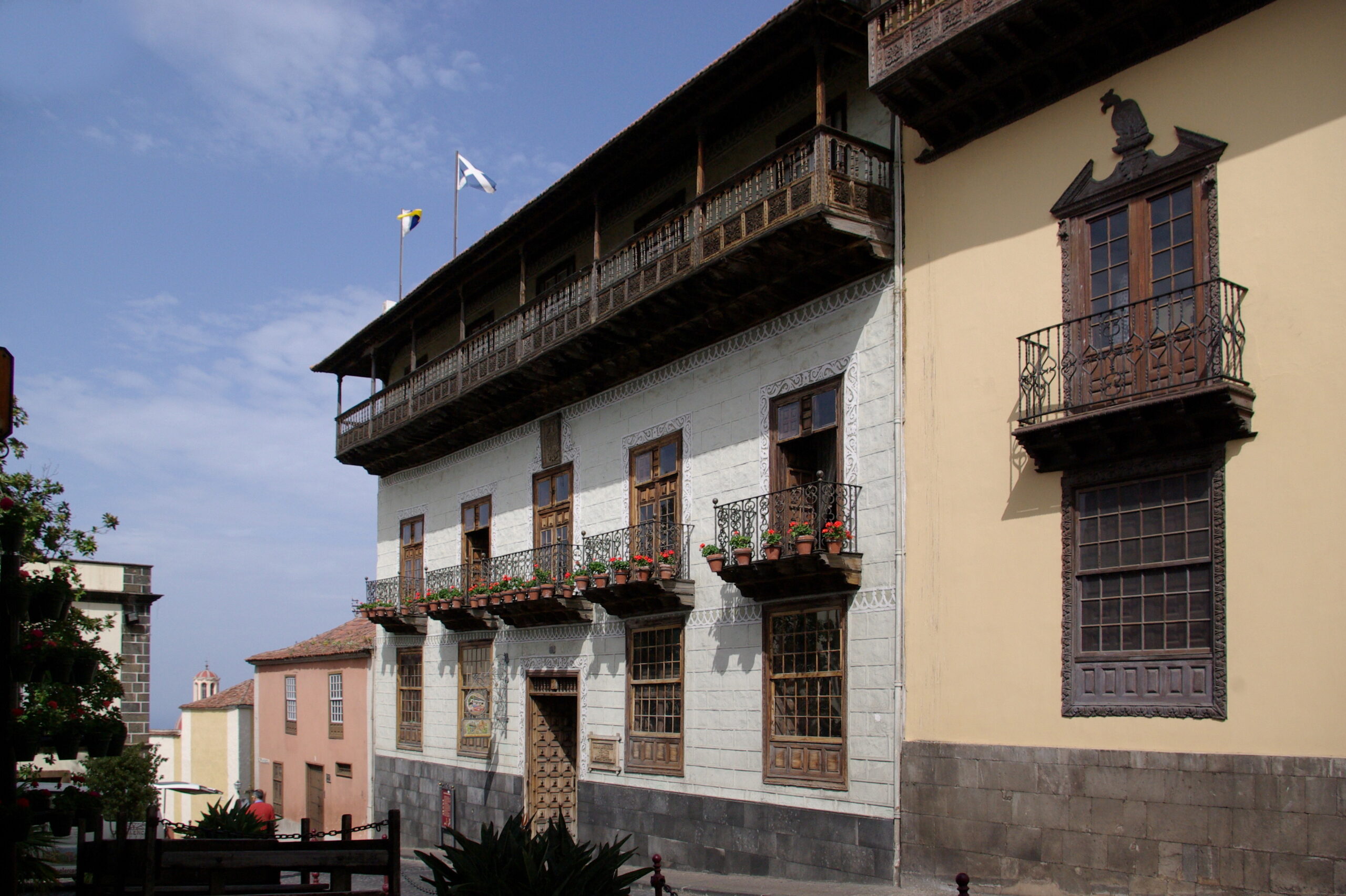
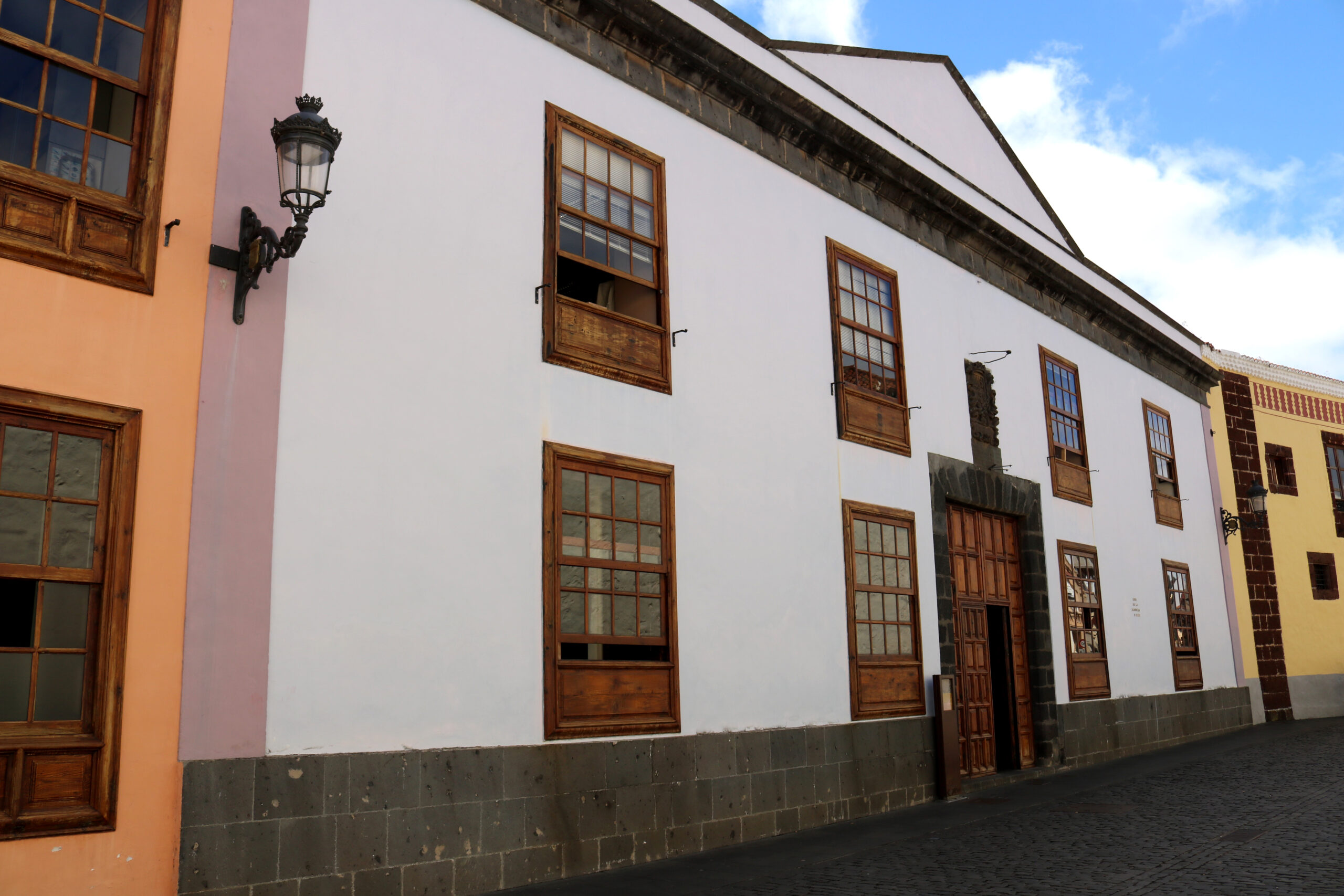
    Start with the tea-pine balconies: carved, covered galleries of pino tea, the resin-saturated heartwood of the Canary pine, so dense it shrugs off centuries. The best streets for them are Calle San Francisco in La Orotava, Plaza de la Pila in Icod and Calle San Agustín in La Laguna. Behind them hides the second word, the patio — austere facades open onto plant-filled galleried courtyards, and you can step into Casa Salazar in La Laguna (free) or Casa Lercaro in La Orotava (also free; it is now shops and a restaurant) to see the trick.

    The third is the Mudéjar ceiling, geometric coffered woodwork inherited from Moorish craft: look up in Icod’s San Marcos and on the convent staircase in Garachico. The fourth is everywhere once you notice it — whitewash and basalt, lime render framed by near-black volcanic stone quoins, the signature contrast of every old street in the north.

    La Laguna: the UNESCO grid

    A World Heritage town since 1999, La Laguna’s unfortified grid became the template for Spanish colonial cities across the Americas. The one interior to pay for is Casa Lercaro, home of the island’s history museum (€5, and free on Friday and Saturday afternoons from four o’clock, the best hack in this post). The cathedral (€7 with audio guide, closed to visits on Sundays) claims Spain’s largest collection of Byzantine icons, and the Concepción tower — the city’s emblem — can be climbed for pocket change on Tuesday to Saturday. One warning: the famous Palacio de Nava facade is exactly that, a facade. The palace has stood empty for decades awaiting restoration, so admire it from the plaza and promise nothing more.

    La Orotava, Garachico, Icod

    La Orotava stacks its mansions up a hillside: the Casa de los Balcones (about €6; twenty rewarding minutes for architecture lovers, a craft shop for everyone else), the finest baroque church in the islands (visits Tuesday–Friday, late morning only), and a working seventeenth-century gofio mill still grinding on Calle Colegio. Garachico is the town a volcano froze: Tenerife’s richest port until the 1706 eruption filled its harbour, it rebuilt in slow stone and then simply stopped — which is why its plaza, convent (Mudéjar staircase inside) and the 1577 Castillo de San Miguel (€2) survive so completely. Icod keeps the treasure nobody expects: inside San Marcos church, a 2.4-metre, 47-kilo silver filigree cross made in Havana in the 1660s, reputedly the finest such work anywhere.

    Planning the day

    From Los Gigantes the natural pairing is Garachico plus Icod over the Erjos pass (about forty minutes to the first); La Orotava sits an hour away and pairs with Los Realejos, whose Santiago Apóstol church was founded the very day the conquest of Tenerife ended in 1496: the island’s first parish. La Laguna deserves its own day. Go Tuesday to Friday: Sunday closes the cathedral, Monday the tower, and La Orotava’s church keeps bankers’ hours.

  • Healthcare in Los Gigantes: emergencies, hospitals and pharmacies

    Healthcare in Los Gigantes: emergencies, hospitals and pharmacies

    Nobody plans to need this page — which is exactly why it exists. Details below were verified against official sources in July 2026; phone numbers and rotas change, so the official links are given wherever they matter. Nothing here replaces medical advice.

    In an emergency: 112

    One number covers medical, police, fire and sea rescue, free from any phone, 24 hours a day. The Canary Islands’ 112 centre answers in Spanish, English, German, French and Italian, with interpreters for dozens more languages. Call it for chest pain, stroke signs, breathing difficulty, heavy bleeding or unconsciousness, give your location first (street and urbanisation; the town is Puerto de Santiago, municipality Santiago del Teide), and stay on the line. On the water, 112 works too; Salvamento Marítimo’s direct line is 900 202 202, and boats use VHF channel 16.

    Where the hospitals actually are

    • Closest 24-hour emergency department (private): Hospital Quirónsalud Costa Adeje, San Eugenio (roughly 25–30 minutes) — walk-in, adult and paediatric. Hospiten Sur in Playa de las Américas (about 30–35 minutes) is the long-standing tourist-oriented private ER, multilingual and used to dealing directly with travel insurers.
    • Closest public A&E: Hospital del Sur at El Mojón, Arona (roughly 35–40 minutes) — a full 24-hour emergency service, adult and paediatric, treating some sixty thousand emergency patients a year. The island’s big reference hospitals (La Candelaria, HUC) are over an hour away; for the most serious cases the ambulance decides where you go.
    • Out of hours nearby: the public night-urgencias point closest to Los Gigantes is in Alcalá (evenings through to morning), with daytime urgent care at the Guía de Isora health centre. When in doubt, call 112 rather than driving to a closed door.

    EHIC and GHIC: what they really cover

    The EU EHIC and UK GHIC entitle you to medically necessary state treatment on the same terms as residents. That means the public system only: the local GP surgery (there is a small consultorio on Calle El Herrador in Puerto de Santiago; it is a doctor’s office, not an emergency unit) and public hospitals like Hospital del Sur. Bring the card plus your passport. It does not cover the private clinics that dominate the tourist coast, prescriptions are part-paid rather than free, and there is no repatriation cover — which is why travel insurance remains essential even for EU citizens. At a private ER without it, expect to pay up front.

    Pharmacies: your first stop for small things

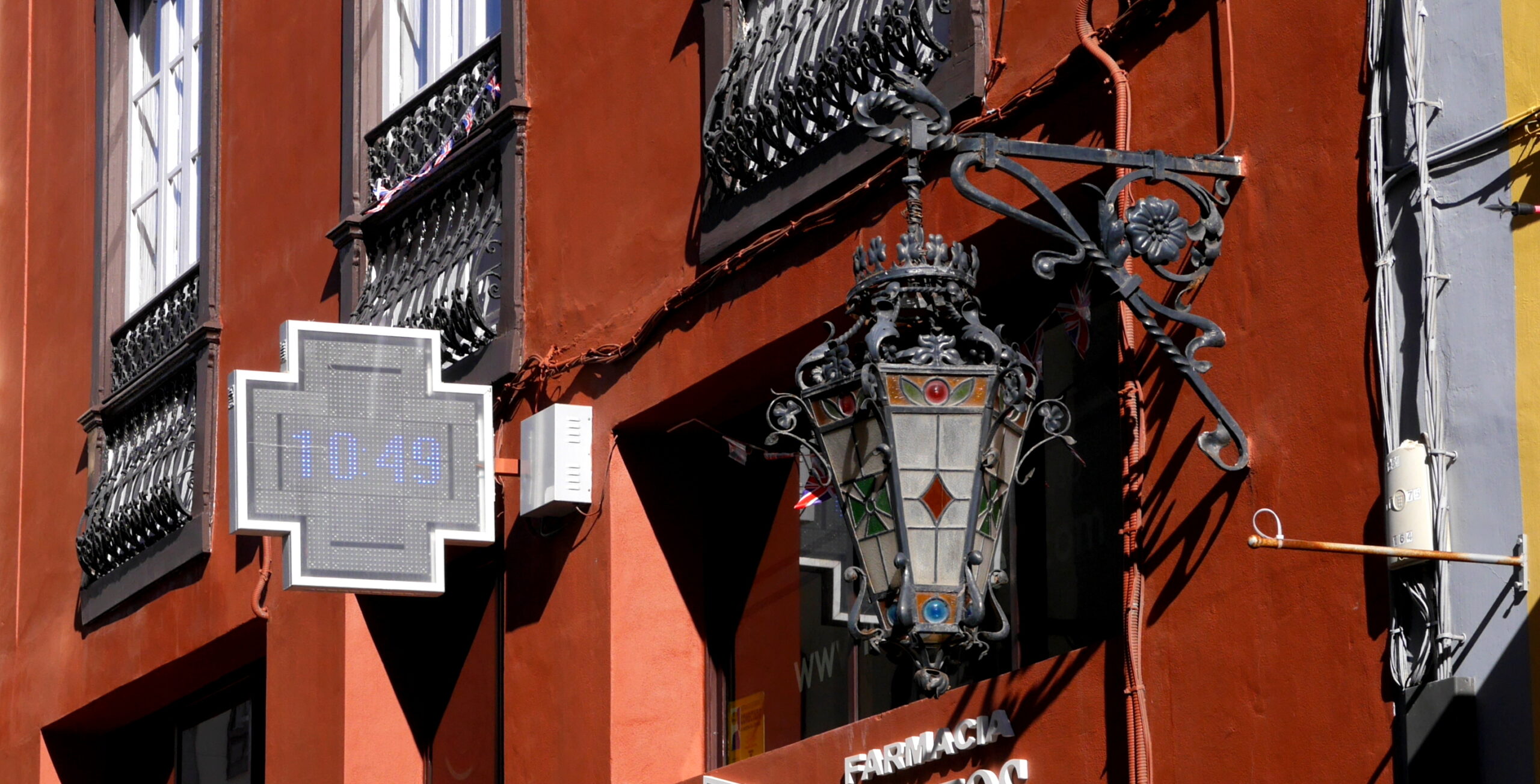
    Spanish pharmacists handle minor ailments with real authority, and plenty of medicines kept behind prescription walls elsewhere are available over the counter here (antibiotics, officially, are not). Locally: there is a pharmacy on Calle Flor de Pascua in Los Gigantes itself, another on Avenida V Centenario in Puerto de Santiago with long weekday hours, and the most useful one to remember at Playa de la Arena, open every single day including Sundays. Pharmacies close at night, but you are never left without one: they take turns staying open, so somewhere between Santiago del Teide and Guía de Isora one pharmacy is always on duty, and which one changes from day to day. Every pharmacy window posts tonight’s duty address, and the full rota is at coftenerife.es.

    Travelling with regular medication? Bring more than you need, keep it in its original packaging and carry a copy of the prescription or a doctor’s letter. If you do run out, be ready for one extra step: an EU prescription that meets the cross-border rules may be accepted at the pharmacy directly, but most visitors, including those from the UK, will first need a local doctor to write a Spanish one, either at a private clinic (roughly €50–100, English spoken, July 2026) or, with a GHIC or EHIC, as a temporary patient at the public health centre in Puerto de Santiago. One firm exception: controlled medicines such as opioids, sleeping tablets, benzodiazepines and ADHD drugs are very hard to have re-prescribed here — pack your full supply and a doctor’s letter for those.

    The small stuff, quickly

    • Sunburn — shade, cool showers, aftersun and water; the west coast is the hottest corner of the island, and children burn through cloud.
    • Jellyfish: out of the water, rinse with seawater (never fresh), no rubbing; lifeguard or pharmacy next, 112 for breathing trouble.
    • Sea urchins — a rocky-entry classic: tweezers for visible spines, a hot-water soak for the pain, disinfect, and see a doctor if spines sit deep.
    • Dental: multilingual dental clinics in Los Gigantes and Puerto de Santiago advertise emergency slots; call ahead.

    Photo: Ronny Siegel, CC BY 3.0, via Wikimedia Commons

  • Charcos: wild swimming, the Canarian way

    Charcos: wild swimming, the Canarian way

    Where lava met the Atlantic, it left basins of clear seawater in black rock: charcos, refreshed by every tide. Swimming in one on a calm morning is the best free thing this island does. The same pools, in swell, are the most dangerous places on the coast — and that is not a figure of speech here. This guide holds both truths at once.

    December 2025, at our own front door

    The Charco de Isla Cangrejo sits below the cliffs a few minutes’ walk from the Los Gigantes marina: comfortable stairs, a sheltering wall, a lovely pool. On 7 December 2025, during a coastal alert, with the pool taped off, fenced and signposted in three languages, a wave came over the wall and swept some twenty people into the sea. Four died; one was never found. The barriers had been in place for days. This post exists so that no guest of ours ever ducks under one: when a charco is closed, it is closed because the ocean has already decided. Whether and when Isla Cangrejo reopens is a local decision — ask, and obey what you find.

    The pools worth knowing

    Closest to home is the Charco de La Jaquita in Alcalá (~15 min), the west coast’s most comfortable charco, recently improved and reached on foot along the promenade. The star is El Caletón in Garachico (~40–45 min): a whole complex of pools in the 1706 lava, free, in the town centre, with lifeguards in the summer season and closure practice locals actually respect. Charco Los Chochos at Los Silos (~50 min) is wild and lovely, a short coastal walk from the car park with no facilities at all — bring everything and check the tide.

    Further round the north coast, Charco del Viento in La Guancha (~55 min) is a deep pool behind two lava arms, with rebuilt stairs and slippery rock; a calm-day-only proposition. Charco de La Laja at San Juan de la Rambla (~1 h) is the north’s most photographed pool, and its most instructive: in January 2025 police physically cordoned it off because visitors kept ignoring the warning signs in heavy seas. Bajamar and Punta del Hidalgo (~1 h 20) are the safe option — semi-built pools with Blue Flags (2026), lifeguards and easy access, the right choice with children or on a swell day.

    The numbers, plainly

    The Canary drowning-prevention association counted 69 drowning deaths across the islands in 2025, with Tenerife the worst island. Natural pools and rocky coast together accounted for over forty per cent of incidents. The figure that matters most: nearly half of those who died were in the water while an official coastal alert was active. The single biggest thing you can do for your safety here is free — respect the closures.

    The local rules

    • Swim at low or mid tide on calm days; October to March brings the big north swell.
    • Watch the water for ten full minutes before getting in — wave sets arrive in groups, and a flat spell between them is the trap.
    • Never turn your back on the ocean; wear water shoes (algae, urchins); no diving — depths change with the tide.
    • If someone is swept in: throw something that floats and call 112 — do not jump in after them; rescuer drownings are a recurring pattern. If it is you: swim away from where the waves strike the rock, let the current carry you out until it weakens, signal, and wait.
    • Take your litter, skip the shampoo — these pools breathe with the open sea.
  • Volcano country: Teide, the 1909 eruption and the fire islands

    Volcano country: Teide, the 1909 eruption and the fire islands

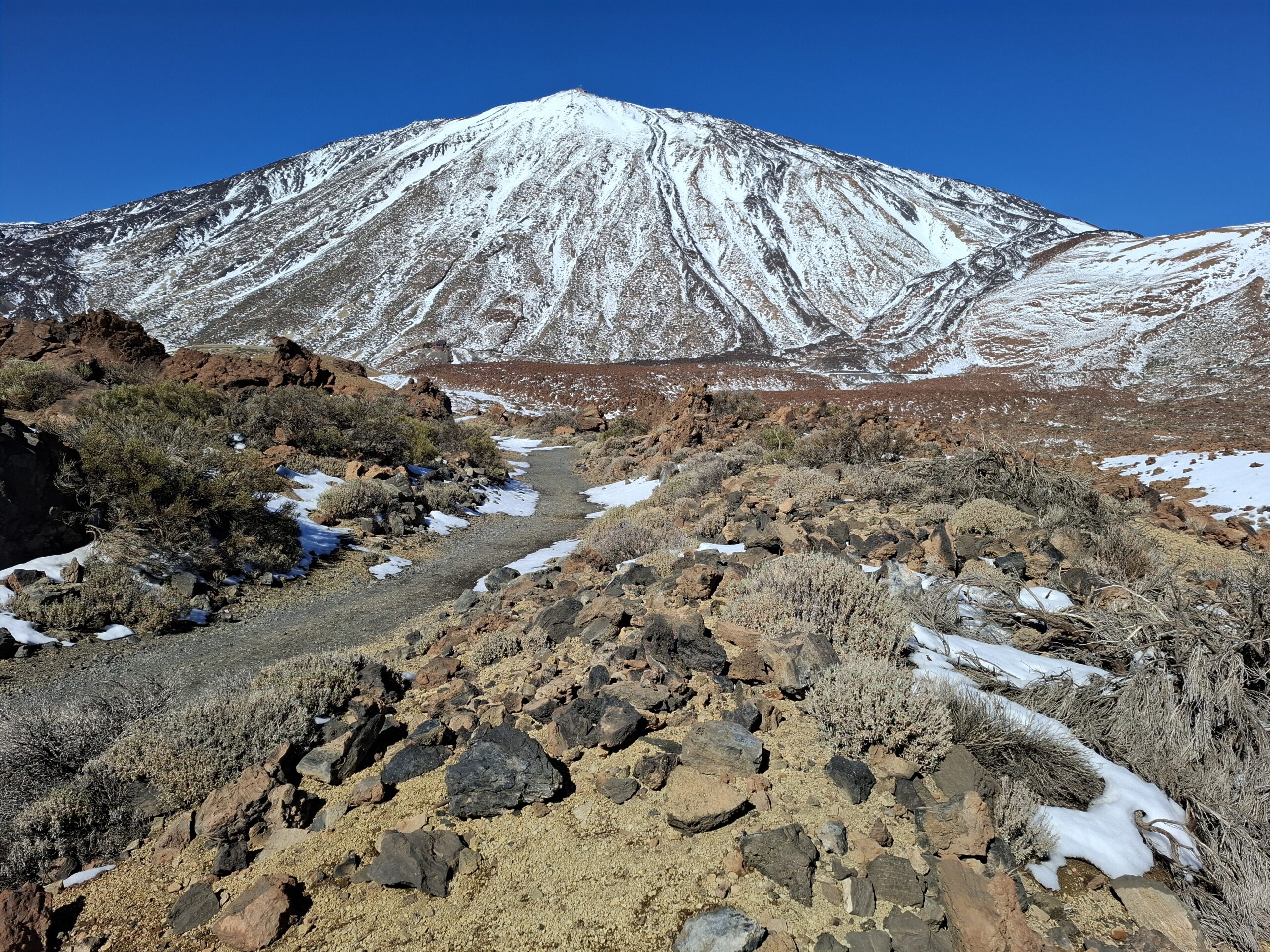
    Everything you stand on here was once liquid. The Canaries are volcanic from shoreline to summit, and Tenerife wears the evidence openly: Los Gigantes’ cliffs are stacked lava, the 1909 Chinyero cone smokes with pine forest twenty minutes uphill, and above it all rises Teide — 3,715 metres, Spain’s highest peak, a UNESCO World Heritage national park since 2007. Prices and rules below are as in force in July 2026.

    Doing Teide properly

    The cable car (official operator Volcano Teide) climbs from 2,356 m to 3,555 m in eight minutes. It costs €42 return for non-resident adults (€21 for children), runs from 09:00 daily, and is prone to wind closures, so go early and book ahead. The last 160 metres to the crater rim are permit-only, and here is the change most guides have not caught up with: since 19 January 2026 the summit permit is no longer free. It costs €15 for non-residents, booked on the Cabildo’s tenerifeon.es platform, where each week’s block of roughly 200 daily places is released on Monday mornings and popular dates vanish within minutes. Plan four to eight weeks out, or book a guided summit package that includes the permit (top-rated ones run around 4.8 across hundreds of reviews, from about €149 with pickup). No permit? The free trails to the Pico Viejo viewpoint and around the Roques de García deliver the moonscape without the paperwork — and respect the altitude: the upper station sits at 3,555 m, which everyone feels.

    Four eruptions to know

    The first is 1706, when the Montañas Negras buried Garachico’s harbour; the town’s lava pools are its unlikely consolation prize. In 1798 came Narices del Teide, three months of flank eruption on Pico Viejo and the longest in the island’s records — Teide’s own summit crater has been silent for roughly a thousand years. Chinyero followed in 1909: ten days, in this very municipality, and the walking loop through its lava is covered in our hiking guide.

    The fourth is Tajogaite on La Palma, which ran for 85 days in 2021, the island’s most destructive on record. Its crater zone now opens only with authorised guides (~€40, outstanding reviews); viewpoints and boat trips to the lava delta are free.

    Lanzarote’s fire mountains

    If the archipelago’s volcanism grabs you, Timanfaya on Lanzarote is the pilgrimage: the 1730–36 eruptions buried a quarter of the island, and the park’s bus route plus the geothermal demonstrations (water flashing to steam, brushwood igniting in a borehole) remain unmatched theatre. The official ticket is €30 (many blogs still quote €20; the park’s own shop says otherwise) with timed online booking now required.

    Is it safe to holiday on a volcano?

    Yes, and the specifics are more reassuring than the vague version. Teide has produced small seismic swarms through 2025 and 2026. The monitoring institutes INVOLCAN and IGN state plainly that these do not raise eruption probability, attribute them to hydrothermal fluids, and keep the alert at green, the lowest of four levels, under one of the densest monitoring networks in Europe. The same instruments gave La Palma days of warning in 2021. You will feel nothing; the volcano is simply breathing, and a hundred stations are listening.

  • Nights out: bars, clubs and late music from Los Gigantes

    Nights out: bars, clubs and late music from Los Gigantes

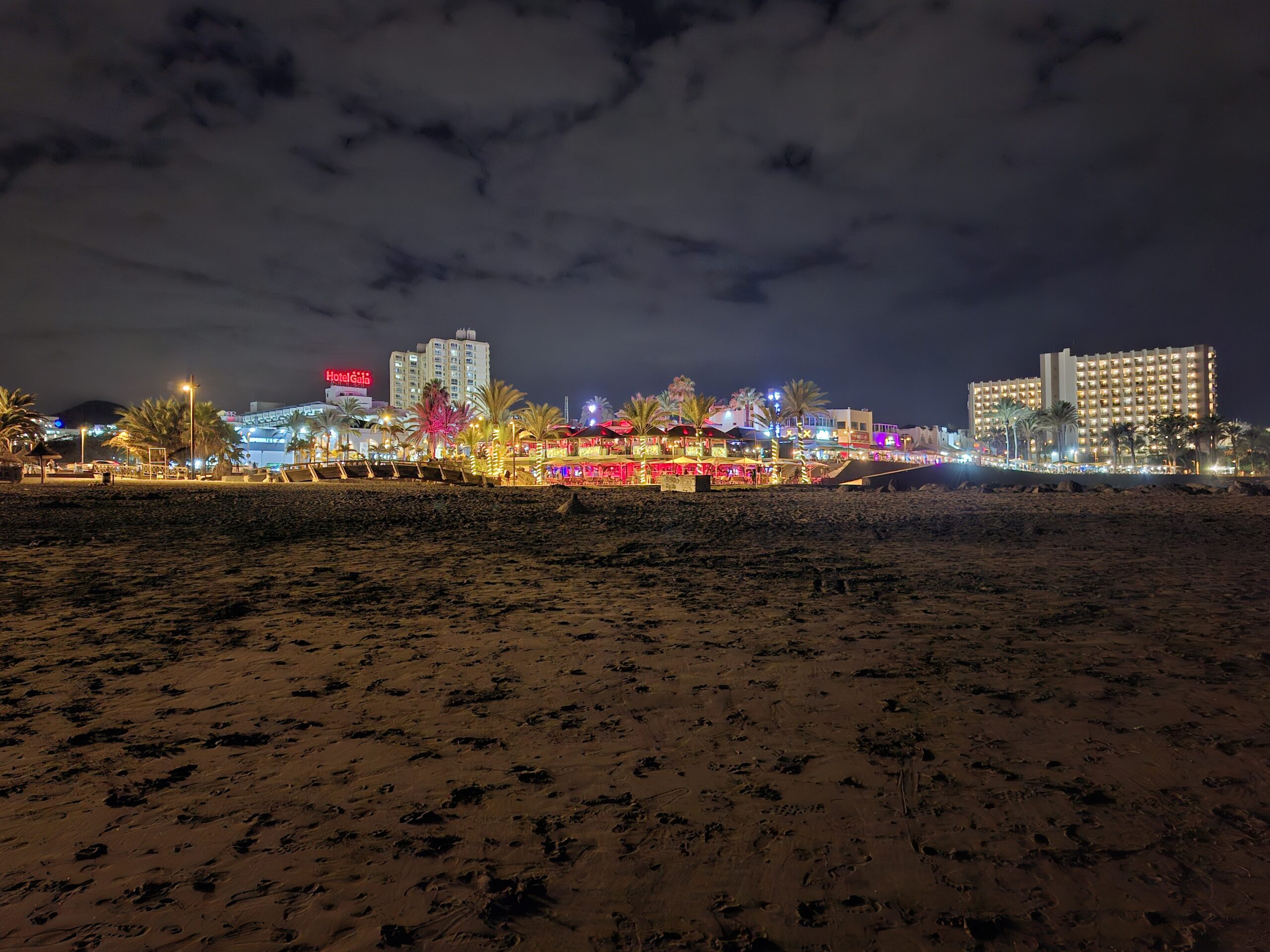
    Los Gigantes is not a clubbing town, and most guests are glad of it. Evenings here mean a harbour terrace, a live set in a pub, karaoke if the mood strikes. When a proper night out calls, the loudest strip in the Canaries is thirty-five minutes south. Ratings are from review platforms as of July 2026; bar line-ups change, so treat nights and acts as indicative.

    On your doorstep

    Highland Paddy in Los Gigantes is the town’s night-time engine room: sport by day, a live singing show from about nine, karaoke to around 2am, most nights. It sits around 4.3 on Google, takes cash only, and fills up, so arrive early for a seat. Over in Puerto de Santiago, Route 66 is the west coast’s best live-music bar, with rock and covers nightly from about ten — over a thousand reviews and a fixture of the local “what to do” lists. Tipsy does open-air drinks and regular live music, holding mid-4s across platforms with thousands of reviews.

    For a quieter glass around the marina, KV Bar Gourmet (4.8), Puravida (4.8) and Pepi Vintage Room (4.5) cover cocktails, Belgian beers and a slow sunset; The Wine Bar in Puerto de Santiago adds live acts and cabaret nights.

    In summer, watch the town-hall square in Santiago del Teide: the municipality’s open-air GiganFest and Friday-night events in Plaza Buganvilla appear on the ayuntamiento’s channels.

    The big night out — Las Américas

    The Verónicas strip remains Tenerife’s party epicentre — three hundred metres of bars and clubs running to 6am, young, loud and hustled by PRs; couples should know what they’re walking into. Its flagship, Tramps, has run for over thirty-five years, keeps strong security reviews, and stays open nightly until six (entry typically includes a drink; prices are posted on the night). For a dressier evening, Papagayo Beach Club does dinner-into-DJs on the sand (around 4.0 across thousands of reviews; smart-casual, book ahead), while the grown-up tier is on the rooftops — Zambra SkyBar at the GF Victoria pours €16 cocktails over a 360° view. Two more worth knowing: the Music Hall Tavern comedy drag dinner show (about 4.6 across hundreds of reviews, family-friendly by design), and the casino by the Gran Tinerfe — €3 entry, passport required, closed shoes, roulette from small stakes until 4am. Hard Rock Hotel’s Children of the 80s parties are a west-coast favourite that ends by midnight; 2026 dates were unannounced at the time of writing, so check their site.

    Getting home at 3am

    The 473 bus is fine for getting there, but do not count on it after ten or eleven at night. A taxi back runs roughly €45–65 on the meter, and experience teaches one thing above all: pre-book your return, because availability at the Las Américas ranks between three and six in the morning is a lottery. Standard strip caution applies — keep your drink in hand, be sceptical of €1 cocktail deals, and stick to the bigger named venues. The strip is rowdy rather than dangerous.

  • Old stones, living hands: historical villages and traditions of Tenerife

    Old stones, living hands: historical villages and traditions of Tenerife

    Tenerife’s postcard is beach and volcano, but its memory lives in small towns, and the west coast puts you unusually close to the real thing. Details and dates below were verified in July 2026; fiestas move with the church calendar, so confirm the day before driving.

    Start ten minutes away: Arguayo

    The hamlet of Arguayo, just up the valley, holds the most local tradition of all: the Centro Alfarero “Cha Domitila”, a working pottery centre and museum where ceramics are still made the pre-Hispanic way — no wheel, coils of clay smoothed with seashells, fired in a single-chamber kiln. It is named for the last potter of the old line, entry is free per the current listings (the municipal office confirms demonstration times), and the pieces on sale were made in the room you’re standing in. Closed Mondays.

    Towns worth the drive

    • La Laguna (~70 min) — a UNESCO World Heritage town since 1999: the unfortified grid that became the template for Spanish colonial cities in the Americas, best absorbed by simply walking Obispo Rey Redondo and San Agustín.
    • La Orotava (~55 min): mansions and the celebrated Casa de los Balcones (from about €6, with a combined ticket for a 16th-century gofio mill). In June the town lays its famous flower and volcanic-sand carpets for Corpus Christi, usually the octave Thursday, confirmed by the town hall each spring.
    • Vilaflor (~45 min) is, at roughly 1,400 m, the highest village in the Canaries (one of Spain’s highest, whatever some guides claim) and home of the roseta needle-lace still made around the church square.
    • Candelaria (~60 min) — basilica of the islands’ patroness, guarded by nine bronze Guanche kings along the seafront; on the night of 14–15 August, pilgrims walk here from across the island.
    • Garachico, Icod, Masca and Taganana are each covered in our other guides; all four reward slow feet and a café stop.

    Traditions you can actually attend

    Romerías — harvest pilgrimages with ox-carts, traditional dress and food handed down from the wagons — run from late April to September; Los Realejos and La Orotava host two of the biggest (both fell in May–June this year), and Santiago del Teide holds its own each July. Lucha canaria, the islands’ sand-ring wrestling, has a lovely local twist: in 2025 Santiago del Teide registered its first federated club in forty-two years, with home bouts at the municipal pavilion behind the town hall — check the ayuntamiento for fixture nights. And from roughly November to spring, the north opens its guachinches: family wine taverns limited by rule to their own harvest and a maximum of three home-cooked dishes, found by handwritten roadside signs. Cash, shared tables, no menus — the least commercial dining experience on the island.

    One more for the calendar: on 29–30 November, Icod de los Vinos celebrates San Andrés by sending its youth hurtling down the steep streets on waxed wooden boards while the cellars uncork the new wine.

  • Island hopping from Los Gigantes: La Gomera, La Palma and beyond

    Island hopping from Los Gigantes: La Gomera, La Palma and beyond

    Other islands are day-trip material from a west-coast base, and that is an underrated luxury. La Gomera floats on your horizon every evening; the ferry port that serves it is only half an hour away. Fares and times below are as listed in July 2026; both ferry companies price dynamically, so check before booking.

    La Gomera: the classic day trip

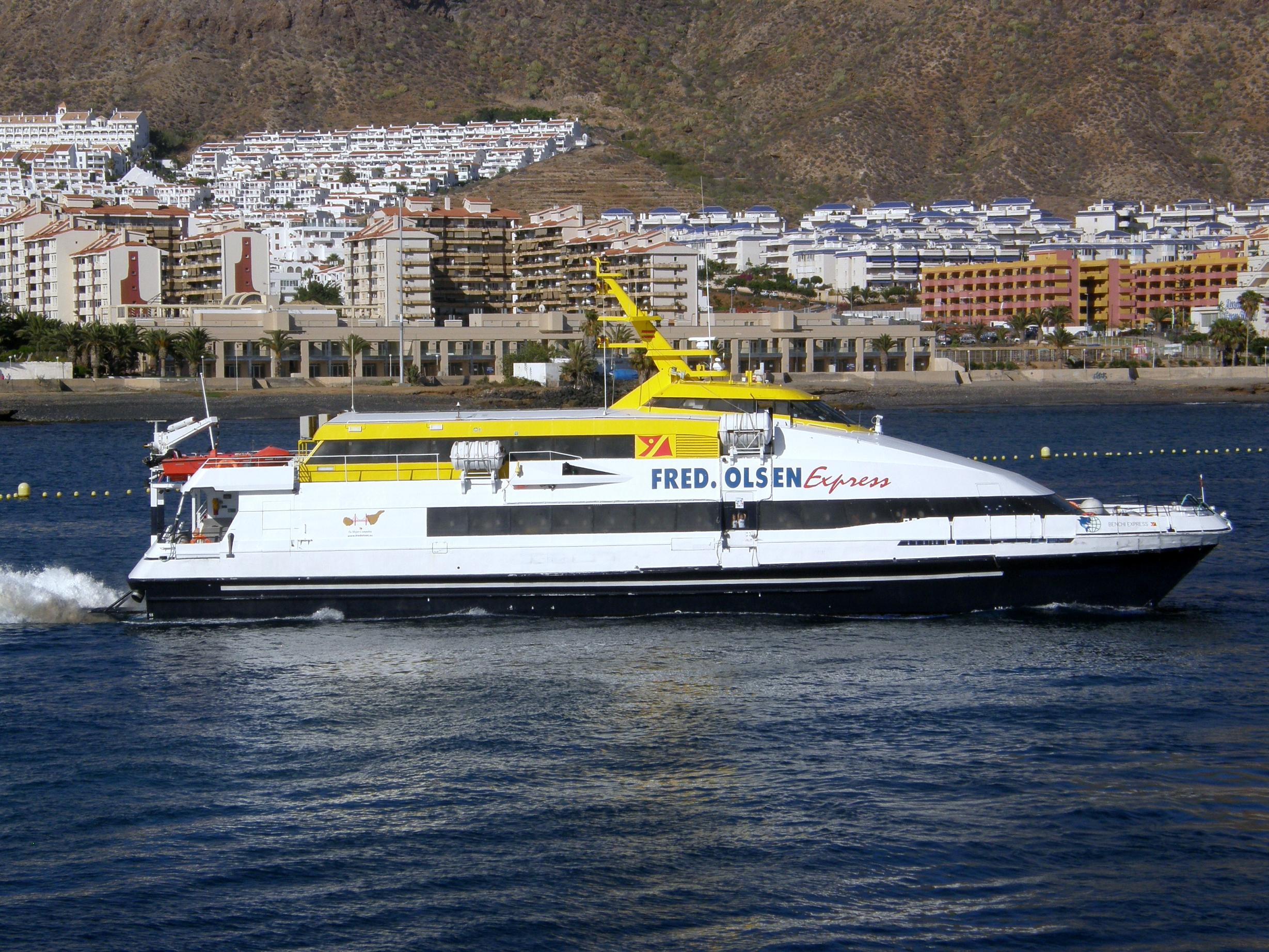
    Fred. Olsen Express and Naviera Armas both cross from Los Cristianos to San Sebastián in about 50 minutes, with six to eight sailings a day between them — out around 08:45–09:30, back as late as 20:00, which buys a full nine-to-eleven-hour island day. Foot-passenger returns start around €85 at non-resident fares. Taking a car adds roughly €21–27 each way, but most hire firms bar their cars from ferries and the local exceptions require written authorisation, so going as foot passengers and joining a tour or hiring on arrival is usually simpler.

    What fills the day: San Sebastián, where Columbus provisioned before the 1492 crossing; Garajonay National Park, a UNESCO-listed laurel forest that has survived since before the Ice Ages; and Silbo Gomero, the island’s whistled language, UNESCO-protected, still taught in every Gomeran school and demonstrated at restaurant stops on most organized tours. Coach-and-ferry day tours with lunch run from roughly €75–100 per person; most pick up in Costa Adeje or Los Cristianos, so plan the short drive to the pickup point.

    La Palma: the green island and the new volcano

    The fast ferry from Los Cristianos takes about two and a half hours (from around €51); Binter’s thirty-minute hop leaves from Tenerife North, an hour and a quarter from here. Three rewards justify the longer crossing: the vast erosion crater of Caldera de Taburiente; daytime guided visits to the Roque de los Muchachos observatory at 2,396 m (about €20, book ahead); and Tajogaite, the 2021 volcano. Its crater zone opens only with authorised guides (around €40 for a three-to-four-hour walk, superbly reviewed), while public viewpoints and lava-coast boat trips from Tazacorte are free alternatives. Realistically this is an overnight rather than a day trip.

    Further afield

    Gran Canaria works as a long day (fast ferry from Santa Cruz, ~1h20 to Agaete with a free bus into Las Palmas, from about €49; or a half-hour flight). Lanzarote and Fuerteventura deserve a night or two: fly Binter or Canaryfly and build the trip around Timanfaya’s fire mountains. El Hierro, the wild end of the archipelago, is about 2 h 30 by Armas ferry from Los Cristianos (from ~€46). Inter-island flights generally run €30–80 one way for visitors — the astonishing fares locals mention include a 75% resident discount — and popular routes sell out weeks ahead in high season.

  • Buying property in Los Gigantes: a practical primer

    Buying property in Los Gigantes: a practical primer

    Sooner or later, most repeat guests catch themselves browsing apartment listings between swims. Fair enough: Los Gigantes is small, supply is finite, and waking up under the cliffs does strange things to financial prudence. Here is the sober version — figures current as of July 2026 and worth re-verifying with professionals before you sign anything.

    The local expert

    This post features Verde’s Tenerife (verdestenerife.com), the resort’s long-established family agency. By the firm’s own account its roots reach back to 1971, when founder Juan Verde de León became one of the pioneers of selling homes in the young Acantilados de Los Gigantes; the agency he created in 1976 is run today by his son, José Juan Verde Villar, from the office at Calle Flor de Pascua 2. Services cover sales, valuations and the full paperwork trail, across Los Gigantes, Puerto de Santiago, Playa de la Arena, Playa San Juan and Abama. Half a century watching one small market is the kind of context no portal gives you.

    What buying actually involves

    • Paperwork first: every foreign buyer needs an NIE (the foreigner’s tax number) and, in practice, a Spanish bank account.
    • The dance — reservation deposit, then the contrato de arras (customarily 10%: walk away and lose it; if the seller walks, they repay double), then completion before a notary typically 30–90 days later. Six to twelve weeks end to end is normal.
    • On a resale, add Canary transfer tax (ITP) at 6.5%, plus notary, registry and gestoría (roughly 1–1.5% combined) and legal fees (typically around 1%). New builds pay 7% IGIC plus stamp duty instead. Budget all-in transaction costs of roughly 8–12% over the sticker.
    • Owning means IBI municipal tax, refuse charges, community fees that vary widely by complex (ask for the real figures per listing), and the non-resident imputed income tax each year (19% for EU residents, 24% for others including the UK, on a small percentage of cadastral value).
    • Financing — non-resident mortgages commonly run at 60–70% loan-to-value. And note: Spain abolished its golden-visa scheme in April 2025, so property no longer buys residency; the Schengen 90/180-day rule applies to non-EU owners.

    The 2025 law every investor must understand

    If your plan is “buy it and rent it to holidaymakers”, read this twice. The Canary Islands’ holiday-rental law in force since 13 December 2025 froze new vivienda vacacional licences for roughly five years while municipalities re-zone — and, per the legal analyses published since, existing licences are personal and extinguish automatically when the property is sold. In plain terms: an apartment advertised “with rental licence” generally cannot pass that licence to you at completion, and a fresh application is, for now, largely impossible. Long-term letting and personal use are unaffected. This single point reshapes the investment maths. Take specialist advice (an agency that knows each complex’s status, plus an independent lawyer) before you offer.

    What things cost

    Portal indices put Los Gigantes at roughly €4,200 per square metre in mid-2026 (a thin market; treat as indicative), with entry-level listings from around €120,000 and realistic sea-view one-bedroom apartments in the €180,000–280,000 band. The stock is finite, the cliffs are not making any more coastline, and the best apartments rarely reach the portals at all — which is where fifty years of local files come in.

  • Shopping on Tenerife: markets, malls and what to bring home

    Shopping on Tenerife: markets, malls and what to bring home

    Nobody comes to Los Gigantes for the shopping — and that is half its charm. But the island around it sells everything from farm cheese to designer sunglasses, often at prices that surprise: the Canaries sit inside the EU customs union but outside its VAT territory, with a low local tax (IGIC, 7% general rate) instead.

    Markets first (days verified July 2026)

    • Alcalá, Monday 9:00–14:00 on the Plaza del Llano: produce, clothes and household stalls ten minutes from your door.
    • Playa San Juan, Wednesday 9:00–14:00, beside the beach.
    • Los Cristianos on Sunday, roughly 9:00–15:00: the coast’s biggest browse; arrive before 11.
    • Torviscas / Costa Adeje runs Thursday and Saturday mornings on the seafront.
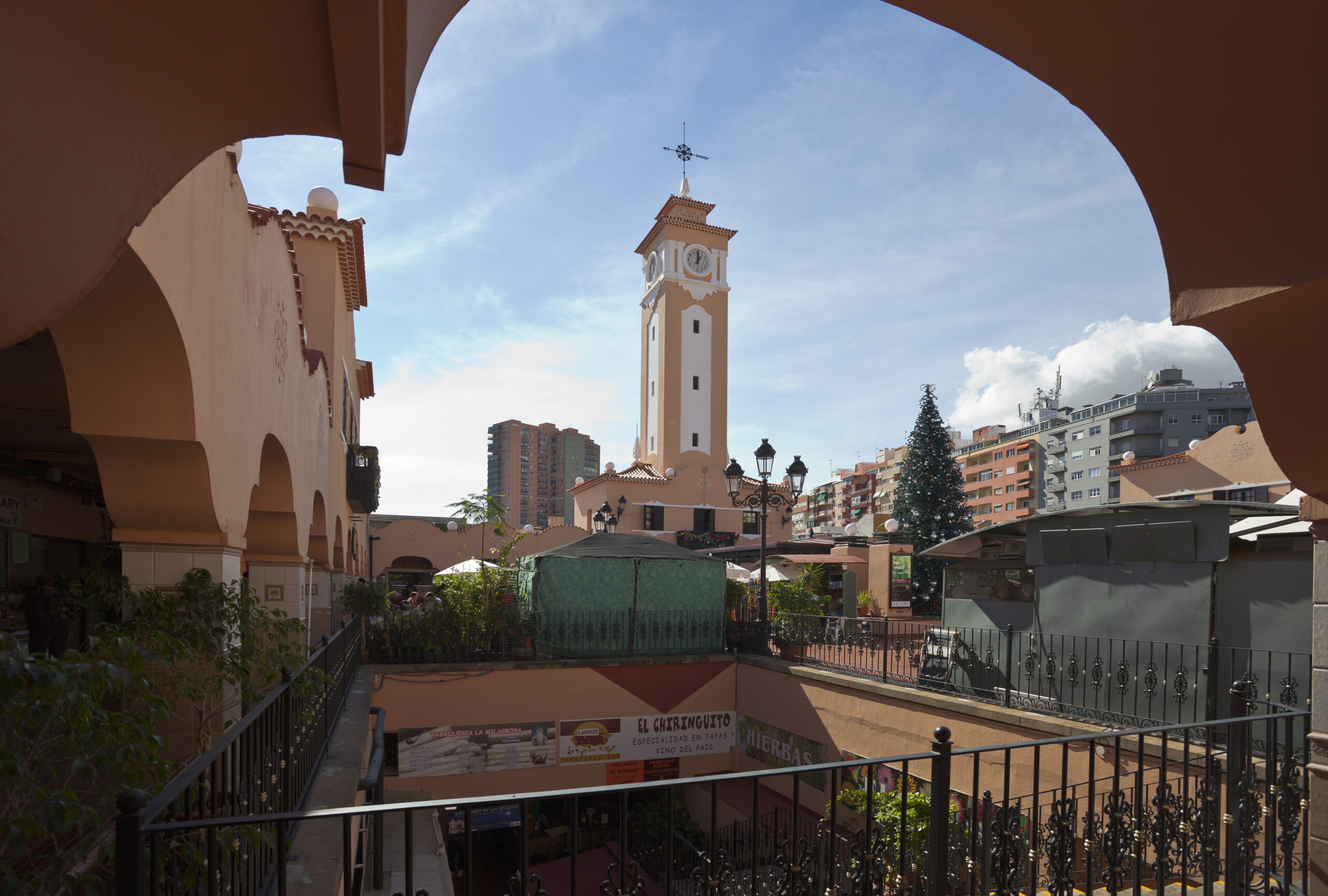
    • Mercado Nuestra Señora de África, Santa Cruz — the island’s handsome 1940s food hall: cheeses, mojo, spices, flowers. Mornings Monday–Saturday, with a lively Sunday rastro; pair with a capital day.

    Malls and boutiques

    For air-conditioned retail, Costa Adeje concentrates it: Siam Mall (open daily to 22:00, free parking and even a free shuttle from the southern resorts) covers the high-street brands, while Plaza del Duque handles the upmarket end. Electronics, perfume and spirits are the traditional Canary bargains thanks to the tax regime.

    Customs: worth knowing before you fly home

    Because the islands are outside the EU VAT/excise area, even travel to mainland Spain or the EU is treated like arriving from outside the EU for these goods: the standard allowances are 200 cigarettes, one litre of spirits and other goods to a value of €430 for air travellers (UK arrivals follow the UK’s own non-EU allowances; see gov.uk). Keep receipts for anything shiny.

    What actually belongs in your suitcase

    Jars of red and green mojo, a bag of toasted gofio, Tenerife wine from volcanic vineyards, banana liqueur, island-farm aloe vera and, if you can keep it cool, smoked Canarian cheese. All of it appears at the weekly markets for less than at the airport.

    Photo: Diego Delso, delso.photo, CC BY-SA 3.0, via Wikimedia Commons

  • Tenerife with kids: waterparks, zoos and animal days out

    Tenerife with kids: waterparks, zoos and animal days out

    Tenerife takes children seriously. Within about forty minutes of Los Gigantes are two waterparks, a world-famous zoo and a handful of smaller animal parks that often end up as the week’s surprise favourite. Prices and ratings below are as published at the time of writing (July 2026); the parks adjust both, so verify on the official sites before you book.

    Waterparks

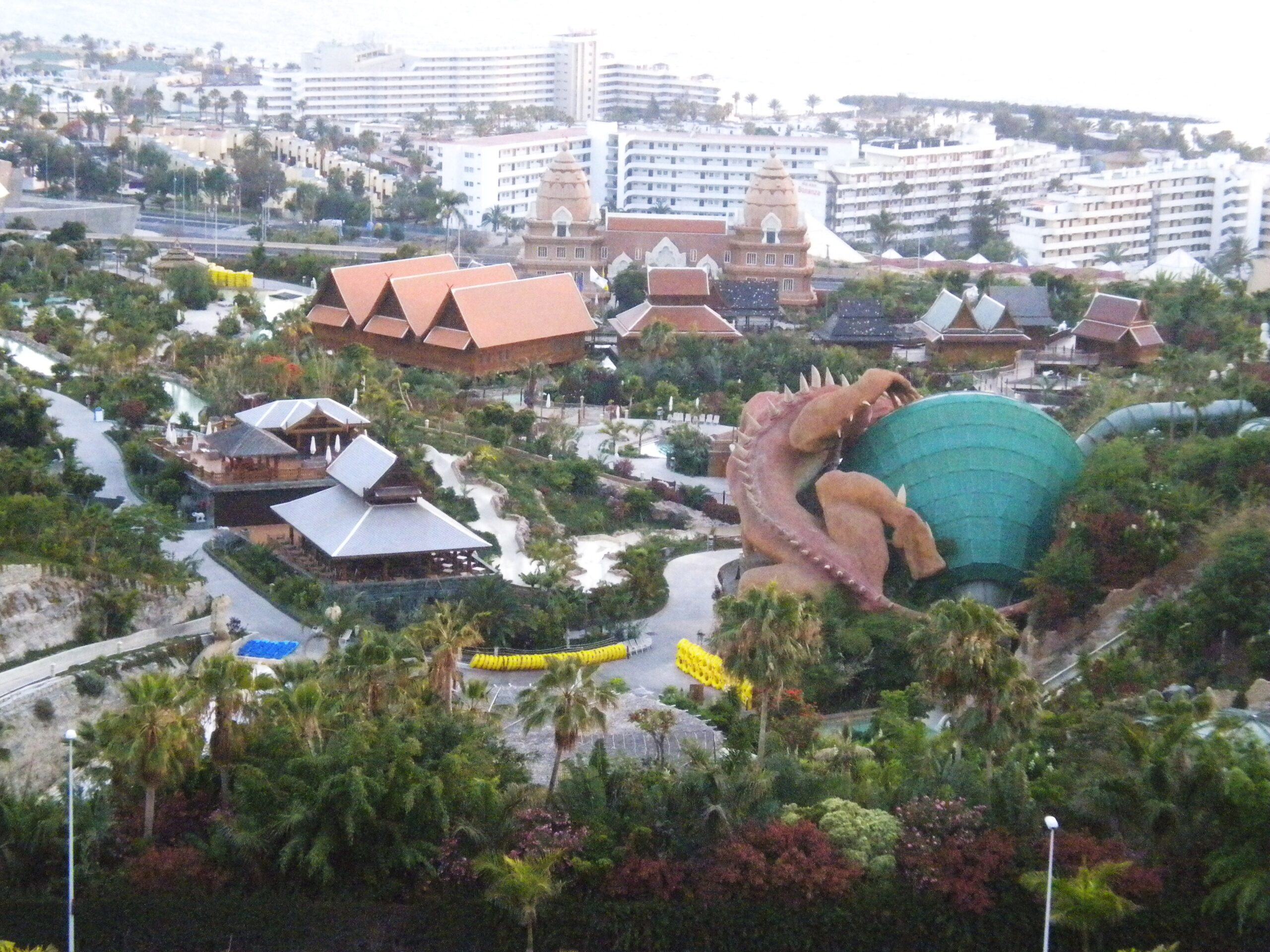
    Siam Park (Costa Adeje, ~30–35 min) has been voted world’s best waterpark a record ten times in TripAdvisor’s Travellers’ Choice awards (as of the 2024 edition), with tens of thousands of reviews averaging about 4.4. Gate prices are listed at €44 adult / €32 child (3–11), under-threes free. The Lost City is a genuinely large toddler-and-junior zone — though the park shines brightest for confident swimmers of six and up. Book online and go early.

    Aqualand Costa Adeje (~30 min) is smaller and cheaper, with online tickets from about €28 adult / €20 child / €12.50 ages 3–4, and the island’s only dolphin show included. Reviews average notably lower than Siam’s, around 3.5–4 across platforms, and travellers weighing animal-welfare concerns may prefer the slides-only parks.

    Animal parks

    • Loro Parque (Puerto de la Cruz, about an hour) — twice voted the world’s best zoo by TripAdvisor users and still the island’s best-rated big park (roughly 4.5–4.6 across tens of thousands of reviews): one of the world’s largest penguin habitats, gorillas and an enormous parrot collection. Listed at €44/€32; the Twin Ticket with Siam Park (about €74 adult / €53 child, valid 14 days) is the standard money-saver for doing both.
    • Monkey Park (near Los Cristianos, ~35 min) is small, hands-on and beloved by parents of under-sixes: €10 adults, €5 children, €3 feed cups, and the lemurs come to you. An easy 90-minute visit rather than a full day.
    • Jungle Park (Arona, ~35–40 min) offers jungle paths, suspension bridges and a genuinely impressive free-flight birds-of-prey show. Listed gate prices rose recently to €36/€29, and the hilly paths are a real workout with a pushchair.

    Closer to home — and free

    The harbour playground fills an afternoon, and a whale-watching trip from the marina — resident pilot whales are seen on most sailings — is the single most memorable “kids’ activity” on this coast. If a north-coast day beckons, the seawater lido of Lago Martiánez in Puerto de la Cruz (listed at €7 adults / €4 children) pairs perfectly with Loro Parque. Keep black-sand afternoons for after four o’clock: the sand genuinely burns small feet at midday.

    Photo: stephen jones, CC BY 2.0, via Wikimedia Commons

  • Evenings out: shows, fiestas and events on Tenerife

    Evenings out: shows, fiestas and events on Tenerife

    The west coast keeps its evenings gentle — harbour dinners, live guitar around the marina — but the island’s calendar carries real fireworks, sometimes literally. Dates below are as announced at the time of writing; programmes firm up on the official pages.

    The big dates

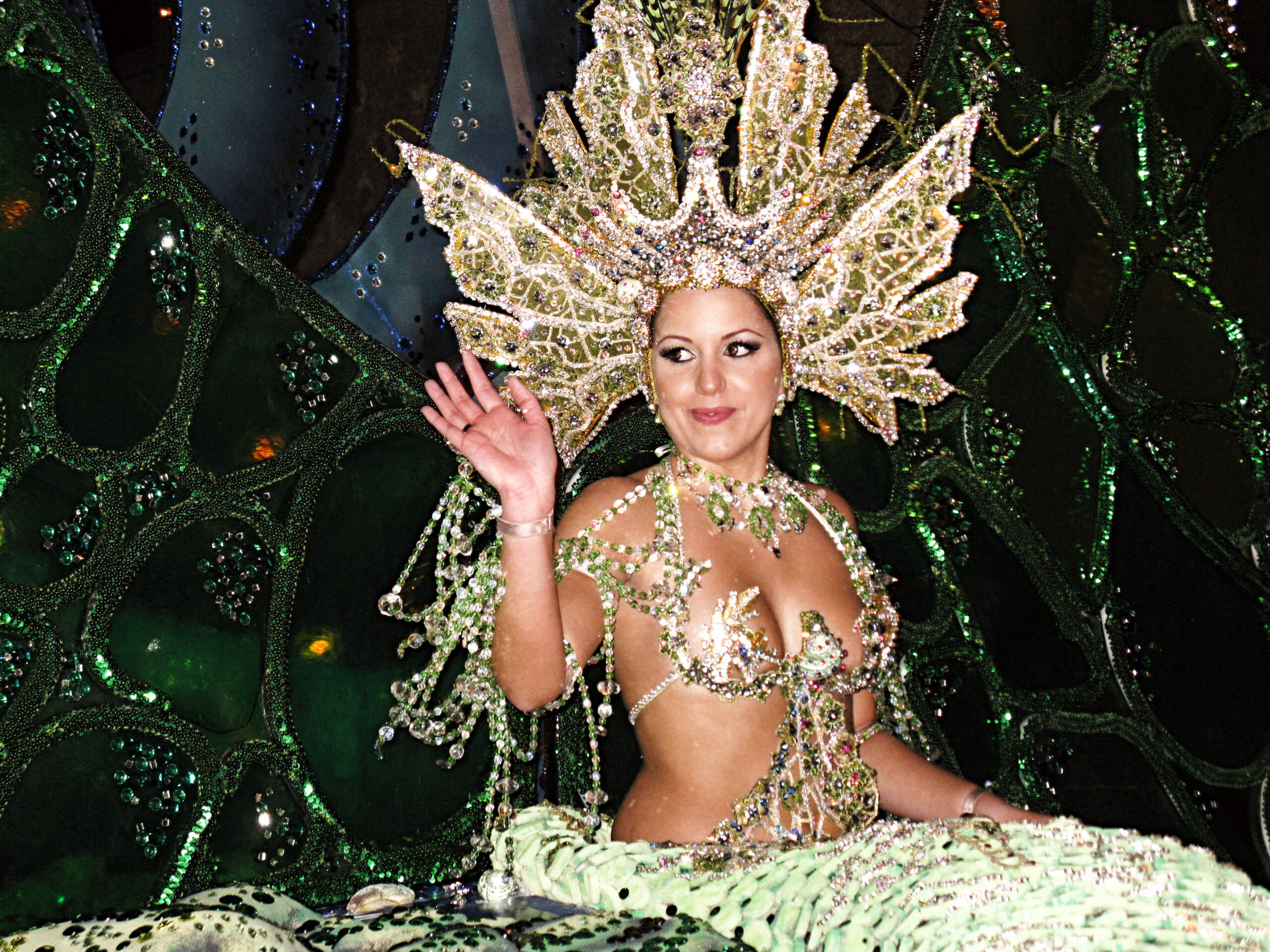
    • Carnival of Santa Cruz is one of the largest carnivals in the world. The 2027 edition is announced under the theme “Roma Eterna”, with the programme opening on 22 January and the main street-carnival week running 19–28 February 2027.
    • Almond blossom, Santiago del Teide (late January–February) — guided blossom walks, craft markets and concerts fifteen minutes up the hill; the 2026 campaign ran 24 January to 22 February.
    • Virgen del Carmen (July): the fishermen’s patroness goes to sea. In 2026 Puerto de Santiago’s fiestas run 3–19 July, and on the main day the Virgin sails from the harbour past Los Gigantes, Alcalá and Playa San Juan, returning to fireworks about 21:00 — the signature spectacle on this very doorstep.
    • Fiestas de Santiago Apóstol, around 25 July, is the municipality’s patron-saint week: verbenas, Canarian wrestling, concerts; the full programme appears on the town hall’s events page.

    Shows and stages

    For a produced night out, the south coast obliges: the Pirámide de Arona stages its flamenco-fusion ballet and music productions (Saturday shows, tickets from about €45), and the long-running medieval tournament at Castillo San Miguel — knights, horses and a banquet eaten with your hands — holds a rating around 4.7 across hundreds of reviews at roughly €50–56 with dinner. In the capital, the sail-shaped Auditorio de Tenerife hosts opera and the symphony at very reasonable prices.

    The quietest show of all

    Teide is a certified Starlight destination, and the official Volcano Teide operator runs sunset-and-stars evenings — cable car at dusk, dinner at altitude, telescopes as the sky ignites. Several formats run at different prices; check volcanoteide.com for current dates.

    Photo: epSos.de, CC BY 2.0, via Wikimedia Commons